
What is Title Search: Process, Challenges, Automation and AI Best Practices
 Oct 5th, 2026

Title search examines property records, claims, ownership history, liens and other issues. Records can be fragmented, complex and difficult to validate. Automation and AI support easy retrieval while human expertise is needed for complex cases and validation.
Table of Contents
What if you bought your dream house, paid all dues, completed the closing and even moved in and then six months later you get a legal notice. Someone pops up as a legal heir or a co-owner to the property claiming that the seller never had the right to sell the property.
A property transaction doesn’t involve only a seller and a buyer. The seller must have the legal right to sell the property.
This is where a title search becomes important.
A title search process digs into all the public records related to the property you intend to purchase. The in-depth search examines tax history, ownership records, liens, unpaid taxes, claims and every detail that could create any ambiguity.
But this is not as simple a process as it sounds. Often records must be collected from different jurisdictions, and old non-digitized records have to be manually searched and retrieved. For very old property manual work is more while where records are digitized it gets simpler. Automation and AI extraction along with matching tools save good amount of time in the title search process.
A technology assisted process which many title search providers use supports quick document retrieval but interpreting the data especially in complex cases requires expertise.
Read on to understand title search process, challenges, automation and AI best practices.
A title search is an in-depth review of public records of the property that helps establish the legal ownership of the property and identifies issues that could affect the ownership transfer.
The search title identifies the legal owner of the property, ownership history, liens and mortgages, easements, title irregularities and any other claims.
Title search identifies issues before closing the deal providing legal and financial protection. It confirms the ownership and identifies any disputes that might arise in future. The search also helps identify that the property is not tied to any unpaid debts, loans or taxes.
It also detects forged documents or unauthorized transactions. A thorough title search helps identify potential title issues before the transaction and reduces the risk of disputes or claims later.
Title search retrieves the documents while title examination evaluates the records. Any issues identified are resolved before the closing.
Title search is often used loosely to cover the whole process, but several distinct steps happen between pulling a record and issuing a policy. Each stage has a different output and is typically handled by a different professional.
| Stage | What It Does | Typically Performed By | Output |
|---|---|---|---|
| Title Search | Retrieves relevant public records tied to the property | Title searcher / abstractor | Collected records |
| Title Examination | Reviews and interprets the retrieved records for issues | Title examiner / attorney | Identified title issues |
| Title Abstract | Summarizes the ownership and transaction history chronologically | Abstractor | Abstract of title |
| Title Report / Commitment | Presents findings and states conditions for issuing a policy | Title professional / underwriter | Title report or commitment |
| Title Insurance | Provides financial protection against covered, undiscovered title defects | Title insurance underwriter | Insurance policy |
A title search can be clean and still not guarantee a defect-free title, see the section below on what a title search does and doesn’t cover.
If ownership issues arise even after a title search, an owner’s title insurance policy can provide protection against certain covered title defects or claims discovered after closing.
Different stakeholders rely on title search findings for different purposes:
Title search includes retrieving various categories of public records from multiple jurisdictions.
For establishing the current legal owner, ownership and deed records are retrieved. This identifies the current recorded owner, previous transfers and other legal descriptions. Next it looks for mortgages and deed records to check whether the mortgages are clear.
The search further looks for any liens and financial claims. Property tax records are also examined to determine whether there are any tax related claims.
Checking for any easement that can remain attached to the property even after ownership changes is also important. This may not be a title defect, but a buyer needs to know if any third party has some rights over the property.
Another important thing to search for are covenants and restrictions that could limit how a property is used. It again may not be a title defect but often covenants and restrictions recorded against the property continue to apply when the property changes hands.
Now that we know what does a title search include, we need to get to the process of retrieving the relevant records. But before we do that, we must have complete clarity on the property whose title search we intend to do.
You need clarity on the property and correct recording jurisdiction before the search begins. But address alone may not be enough. To identify the property accurately locate the correct parcel number.
If there is some ambiguity in the parcel information, the legal description will help you identify the property’s boundaries and parcels in legal records. Identify the county or local recording office where the property’s official records are maintained.
Be clear on search period like how far back you search and what you search. The period would depend on the applicable state requirement, type of transaction and purpose. The requirement isn’t identical everywhere.
Recording systems, indexing practices, available online records and search procedures vary by state and county.
The scope of a title search varies depending on the transaction, property and search requirements. Common types include:
The cost of a title search depends largely on the complexity and scope of the work involved. Older properties may require a deeper review of ownership history, while searches involving multiple jurisdictions can require records to be retrieved from different systems.
Search depth also matters, as a current-owner search requires less historical research than a full chain-of-title search. The level of digitization is another factor. Well-indexed digital records are easier to retrieve and process, while non-digitized or historical records may require manual searching and additional review.
Title search process is a complex process involving a systematic sequence of search verification and review of records.
Broadly the steps can be summarized in 6 stages.
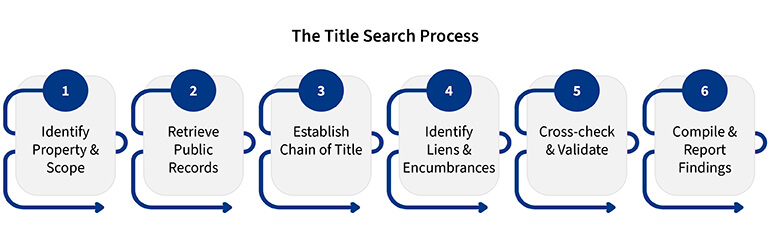
Step 1 – Identify the property and scope – Before you start search you must have clarity on the property address. Correct address, APN/parcel number and legal description will determine the jurisdiction of the property.
The search period and scope should be clearly defined for accurate search and record retrieval.
Step 2 – Identify relevant public records – Based on your search scope and jurisdiction list out all the relevant public records you would need for the title search.
The main ones would be deeds and transfer records, mortgage, lien records, tax records, legal descriptions, easements, covenants and other recorded interests.
Step 3 – Establish the chain of title – Establish the chronological history of ownership transfers. Move backwards and connect each transfer logically. Flag any inconsistencies and gaps.
Verify grantor/grantee names, legal descriptions and continuity between transfers.
Example: Suppose Owner A transfers the property to Owner B, who later transfers it to Owner C, and finally to the current owner. Each deed should connect one owner to the next, while any recorded mortgage should also have a corresponding release where applicable.
Complete chain: Owner A → Owner B → Owner C → Current Owner
Now suppose the records show a transfer from Owner C but the next recorded deed names the current owner without showing how ownership passed between them.
Incomplete chain: Owner A → Owner B → Owner C → ? → Current Owner
The missing link creates a break in the chain of title and should be flagged for further review.
Step 4 – Identify liens and encumbrances – Check for existing loans and mortgages. Any recorded tax liens or unpaid property tax may create claim against the property.
Check for judgment liens, which arise from court judgments against an owner, and mechanic’s liens, where contractors or suppliers may have recorded liens for unpaid work. Easements and covenants must also be identified as they may restrict property usage.
Step 5 – Cross-check and validate records – This is very important step as any name mismatch, wrong address or even a minor data error can make the connection go haywire.
You must cross-check and validate each record. Documents cannot be accepted in isolation; the data must be compared across records to establish accuracy. Match owner names, verify property identifiers, match liens with release, verify dates and finally escalate exceptions.
Step 6 – Compile and report findings – Now once you have all records at one place, verified and validated, present the data in structured usable information.
Start with organizing the ownership history in chronological order so that it gets simpler to follow the chain of title. Separate resolved and unresolved matters and summarize the relevant documents. And most important add supporting source documents for easy tracing and don’t forget to flag issues.
A thorough title search significantly reduces risk, but it isn’t a guarantee of a defect-free title. It’s important to be clear about what the process can and can’t do.
A title search depends entirely on the records that are recorded, indexed and accessible. It cannot uncover:
A search also doesn’t resolve issues on its own. Finding a defect is different from clearing it, curative work (releasing a lien, correcting a name, obtaining a quitclaim deed) has to happen separately, often by an attorney or title curative team.
This is why title insurance exists alongside the search process – it provides financial protection against certain covered defects that a search and examination did not or could not catch, rather than replacing the need for a careful search.
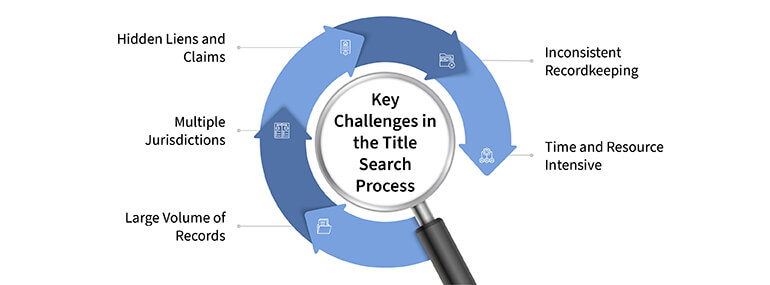
Title search especially for complex cases often gets challenging and delays the process. Professionals often spend lot of time and effort to ensure a clean title. As per ALTA research 36% of files are difficult, demanding extensive curative work.
Here are some of the challenges which a title team faces while solving title issues.
Fragmented records and jurisdictions are the biggest hurdle in retrieving records. Different jurisdictions have different databases, indexing systems and search methods. All may not have the same level of digitization.
You may have to deal with handwritten and poor-quality documents. Older deeds or records are sometimes still in the form of scanned images requiring manual retrieval.
Complex ownership histories and inconsistent information make matching and validation a big challenge. Name variations, missing information, incorrect spelling add to the problem.
Title search involves huge volumes of files and records. Missing even a single lien can have consequences.
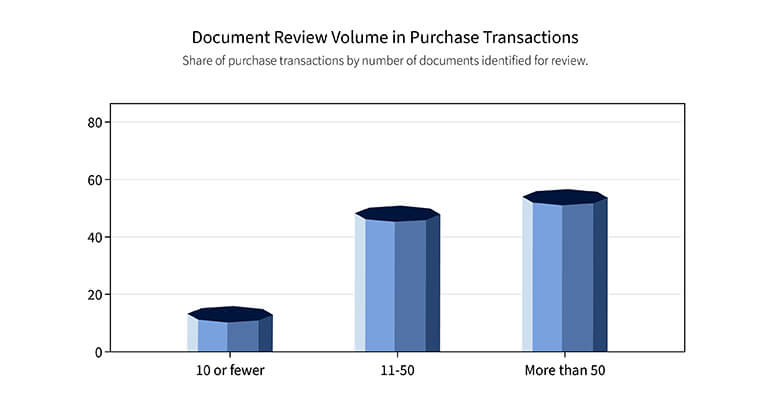
Source: Measuring-the-Complexity-of-Title-Production.pdf
A title search can uncover issues in property records that need further review or resolution before the transaction can proceed. Some common problems include:
Automation supports easier processing of digitized records, while non-digitized records can be scanned and processed using OCR.
Physical deeds and historical records can be scanned to create digital images and then Optical Character Recognition (OCR) converts scanned or image-based documents into machine readable/searchable text.
For handwritten documents advanced OCR/ICR and AI based document processing can be used. Such advanced tools can extract information from faded scans or irregular layouts. But they may require higher level of validation to maintain accuracy.
Automated title search can take over repetitive and rule based activities. Different technologies work at different stages of workflow. One tool cannot automate the entire title search process.
Though digitization has made the work simpler, still it doesn’t eliminate the manual work.
| Challenge | Automation/Technology Application |
|---|---|
| Records across multiple sources | Automated search and document retrieval |
| Scanned/non-searchable documents | OCR and intelligent data extraction |
| High document volumes | Automated document classification and indexing |
| Name/property variations | Entity and record-matching tools |
| Complex ownership history | Document linking and chronological organization |
| Liens and releases | Matching of related records and exception flagging |
| Conflicting/missing information | Rule-based and AI-assisted validation |
Automation can support quick searching, retrieving, data entry, classification and matching which helps title professionals spend more time on complex records.
But automation cannot guarantee correct OCR and entity matches. These can produce errors and do require validation.
AI and automation can support different stages of the title search workflow, from document intake to final reporting.
| Pipeline stage | AI/automation application |
|---|---|
| Document intake | Classifies incoming records by document type for further processing. |
| Scanned records | OCR converts scanned or image-based records into searchable, machine-readable text. |
| Historical documents | AI-assisted extraction identifies relevant names, dates, property details and recording information. |
| Names and entities | Entity-matching tools identify name variations and connect related parties across records. |
| Ownership records | Document-linking tools connect transfers chronologically to help build the chain of title. |
| Liens and releases | Matching tools connect liens with related releases and flag potentially unresolved records. |
| Conflicting information | Validation rules and AI-assisted checks flag mismatches, missing information and other exceptions for review. |
| Final output | Verified information is organized into a structured report with links to supporting source records. |
Automation supports faster title search, but to maintain accuracy, certain best practices must be followed.
| Best Practice | How to Apply It | Why It Matters |
|---|---|---|
| Human-in-the-loop review | Route exceptions, conflicting records and complex cases to title professionals | Prevents uncertain AI outputs from being treated as final findings |
| Set confidence thresholds | Define thresholds for automated extraction and matching; send low-confidence results for review | Helps separate routine processing from cases requiring validation |
| Validate against source records | Link extracted names, dates, parcel IDs, legal descriptions and recording details back to source documents | Reduces the risk of OCR or extraction errors moving downstream |
| Use jurisdiction-specific workflows | Configure search, indexing and validation rules according to local recording practices | Avoids applying the same logic to jurisdictions with different record systems |
| Maintain audit trails | Record source, extraction/match results, exceptions and human corrections | Provides traceability and supports quality control |
| Monitor quality continuously | Track extraction accuracy, false matches, exception rates and reviewer corrections | Helps identify recurring errors and improve models/workflows |
Outsourcing title search can help title companies, lenders and legal teams manage search workloads without expanding internal resources for every change in demand. Some key benefits include:
Title search can be both simple and complex process. If the records are digitized with straightforward ownership history, the title clearance is comparatively faster. At the same time if the records are non-digitized within multiple jurisdictions and discrepancies the review time can increase significantly.
Automation and AI can reduce time, but complex cases still require time and expertise. Therefore, more than time the focus should be on a process that balances speed with accuracy and validation.
The best approach would be to combine technology, workflow and title domain expertise for the operations to be more reliable and scalable.
What’s next? Message us a brief description of your project.
Our experts will review and get back to you within one business day with free consultation for successful implementation.

Disclaimer:
HitechDigital Solutions LLP and Hitech BPO will never ask for money or commission to offer jobs or projects. In the event you are contacted by any person with job offer in our companies, please reach out to us at info@hitechbpo.com