
What is Title Search: Process, Challenges, Automation and AI Best Practices
 Oct 5th, 2026
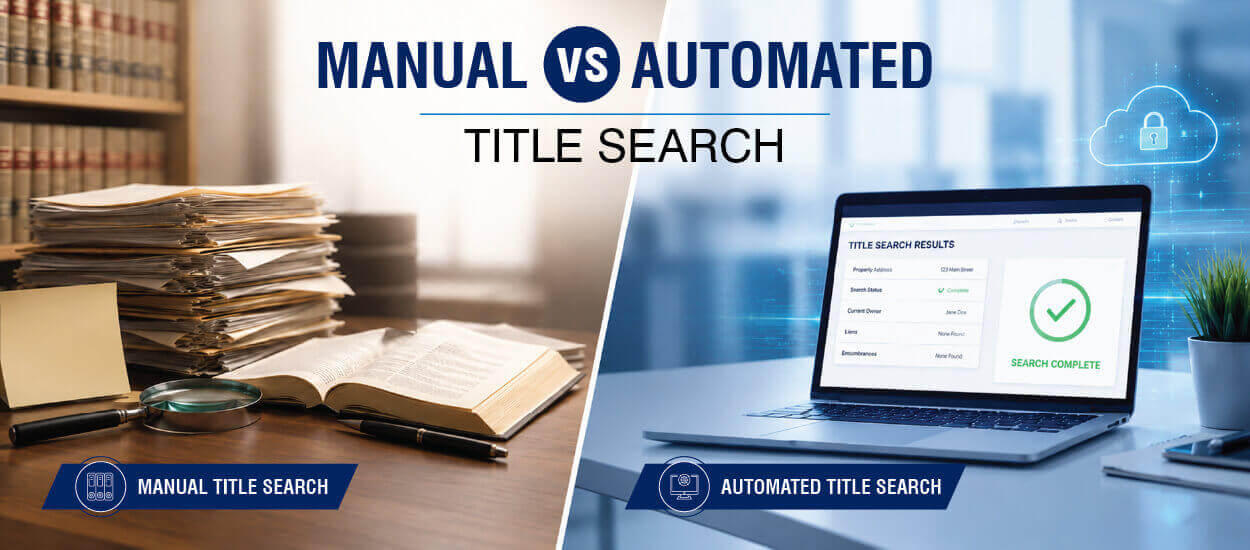
Manual title searches are becoming less efficient as workloads increase. Automation makes the process faster and more accurate with the help of AI technologies such as OCR and NLP. A hybrid approach combining AI and human expertise is likely to shape the future of title search.
Table of Contents
Is your title company able to keep up with rising workloads and closing timelines?
Real estate transactions are increasing day by day and turnaround expectations are becoming closer. Thereby, many title companies are struggling to manage large volumes of county level property records smoothly.
Traditional manual title search processes are important yet time-consuming, labour-intensive, and difficult to scale.
As per the ALTA‘s 2026 study, Measuring the Complexity of Title Production, title professionals spend major time on fraud prevention, with 52% dedicating 11+ hours monthly. Among them, 37% spend 11–50 hours, while 15% spend over 50 hours managing fraud risks.
Modern title companies are adopting automated title search workflows powered by AI-driven technologies such as OCR, NLP, and intelligent document processing.
That does not mean AI is replacing title professionals. Instead, the industry is moving toward a hybrid approach where automation helps streamline record retrieval, document analysis, and data organization, while title experts focus on validation, legal interpretation, and risk assessment.
In this blog, we’ll compare manual vs automated title search and the way automation is complementing modern title operations.

A manual title search is the process of reviewing public property records to verify property ownership and identify legal issues regarding the property. This process is usually handled by title examiners, abstractors, or title researchers.
It is all about building a chain of title by tracking the ownership history of a property and identifying mortgages, liens, judgements, easements, or encumbrances which may affect ownership rights.
This process often involves reviewing years, and sometimes decades, of property records.
“The title process is far more than a document check. It’s a detailed review of a property’s history and a problem-solving process that helps ensure buyers can take ownership with confidence.” – Chris Morton, CEO, ALTA
Now that we’ve covered the basics of manual title search, let’s look at how the process actually works step by step.
The process usually starts when a title company receives an order. The examiner first reviews basic property details such as:
From there, the search moves to county records.
This is where things can become time-consuming. Some county records are easy to access online. Others may require searching through scanned files or courthouse archives.
Once the records are located, the examiner retrieves documents such as:
After gathering the documents, the examiner reconstructs the chain of title. This means tracking ownership transfers in chronological order to confirm who legally owned the property over time.
The examiner also checks for issues like unpaid liens, ownership disputes, or missing transfers.
As you can see, manual title search involves reviewing a large number of records and documents along the way. Automated title search services deliver organized search packages in hours instead of days by reducing the time traditionally spent on data collection.
Manual title searches depend heavily on public records. Some of the most commonly used records include:

Each document helps verify ownership history and identify potential risks. But working with these records is not always straightforward, especially across different counties, so let’s discuss the dependence in the next section.
One major challenge with manual title search is the lack of consistency across counties. Every county in the U.S. handles records differently.
Some counties offer modern digital access. Others still depend on physical files or outdated systems. In many cases, records are only partially digitized.
For title companies handling multi-county searches, this creates delays and operational complexity.
This is exactly where many title companies start facing operational slowdowns and scalability issues.
Manual title search is important, but it often creates challenges around speed, accuracy, consistency, and scalability. Below are some of the major ones:
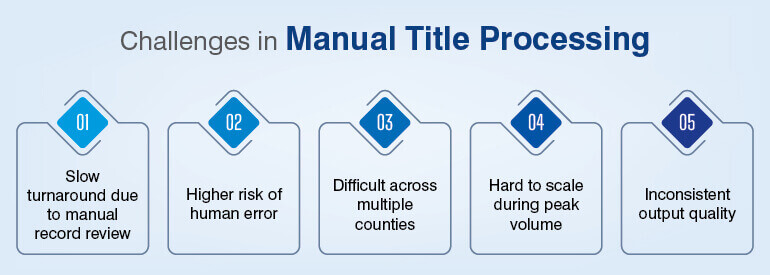
One of the biggest challenges with manual title search is speed.
Title examiners often spend hours reviewing records, locating documents, and verifying ownership history. If records are difficult to access, the process takes even longer.
This can delay title commitment preparation and impact closing timelines.
For title companies handling high order volumes, slow turnaround times quickly become a major operational issue.
Manual workflows also increase the risk of human error. Even experienced title examiners can miss details while reviewing large volumes of records.
A missed lien, incorrect indexing, or incomplete chain of title can create serious legal and financial problems later.
The challenge becomes even bigger when teams are working under tight deadlines.
Things get more complicated when searches involve multiple counties or states. Each jurisdiction may have different systems, naming formats, and record structures.
This makes standardization difficult. It also increases the amount of manual effort required for nationwide title search operations.
Manual processes are difficult to scale during busy periods. When order volumes increase, title companies often need more staff to keep up with demand.
But hiring and training experienced title professionals takes time. Productivity also depends heavily on individual expertise.
As workloads grow, maintaining consistent turnaround times becomes harder.
Another common issue is inconsistency. Different title examiners may interpret records differently. Older documents can also be difficult to read or understand.
As a result, report quality can vary depending on workload, experience, and process standards. This is where automation starts changing the picture.
To solve many of these challenges, title companies are now turning toward automation-powered workflows.

Automated title search uses AI-powered tools and workflow automation to speed up property record analysis.
Instead of manually reviewing every document, the system processes records digitally and extracts important information automatically.
For title companies, this means faster workflows and better operational efficiency.
“Title intelligence is intended to amplify the strengths and deep knowledge of title professionals, highlighting the expertise they bring to every file.” – Said by Steve Vincini, President of First American Title‘s Agency Division.
So, what exactly powers an automated title search process behind the scenes?
Several intelligent document processing technologies work together in an automated title search process.
These include:
Together, these technologies help transform unstructured property records into usable digital data.
One of the biggest advantages of automation is structured data extraction.
Instead of manually reading through every document, the system automatically extracts details such as:
Data extraction with the help of AI makes records easier to organize, search, and analyze. Now let’s break down how an automated title search workflow works from start to finish.
Automated title search streamlines the entire process by using AI and data automation to improve speed and accuracy at every stage.
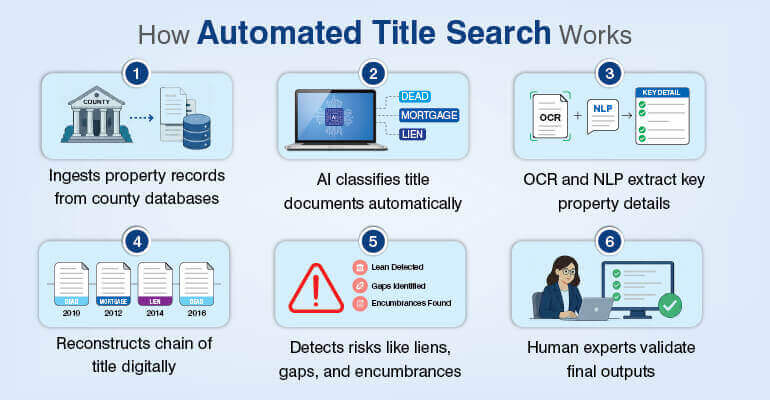
The process starts with collecting property records from county databases and digital repositories.
Modern systems continuously ingest and update county-level property data. This reduces the need for manual document collection.
Once records are collected, AI models classify documents automatically. For example, the system can identify whether a document is:
This helps organize records faster and improves indexing accuracy.
Instead of someone manually reading every scanned file, OCR and NLP models extract important details automatically.
The system can identify:
This significantly reduces manual work. The shift toward digital records has accelerated industry-wide according to the Property Records Industry Association (PRIA), over 85% of the U.S. population now resides in jurisdictions that support eRecording, covering nearly 2,000 recording jurisdictions nationwide. This expansion of digital recording is precisely what makes large-scale OCR and NLP-based extraction practical at the county level.
AI systems can also rebuild the chain of title automatically.
Using data relationships and entity linking, the platform connects ownership records and creates a chronological ownership history. The system can also flag missing transfers or inconsistencies for review.
In some cases, AI-powered document processing is also being used to digitize historical property records and city directories to support ownership timeline analysis and real estate data research.
Modern automation platforms can identify potential risks such as:
This is done using AI models combined with rule-based validation systems. Even a 1% error rate can lead to thousands of title inaccuracies over time.
Even with advanced automation, human review still matters.
Most modern title companies use a human-in-the-loop approach. This means title examiners review high-risk cases, unclear records, or low-confidence AI outputs.
This balance helps maintain both speed and accuracy. With both approaches explained, let’s compare manual and automated title search side by side.
Here’s a quick comparison of manual vs automated title search across key operational areas.
| Factor | Manual Title Search | Automated Title Search |
|---|---|---|
| Speed | Takes hours or days due to manual document review and county-level searches | Processes records much faster, often in near real time |
| Accuracy | Depends heavily on examiner experience and manual interpretation | Uses standardized AI-driven rules for more consistent results |
| Scalability | Requires larger teams to manage growing order volumes | Can handle high-volume workloads without major staffing increases |
| Cost Efficiency | Labor-intensive and expensive to scale | Reduces major work and improves operational efficiency |
| Data Handling | Relies on manual review of unstructured documents | Converts records into structured and searchable datasets |
| Workflow | Mostly dependent on human title examiners and abstractors | Combines automation, AI models, and digital workflows |
| Turnaround Time | Slower due to document retrieval and manual validation | Faster due to automated extraction and processing |
| Consistency | Output quality may vary between title examiners | Delivers more standardized and consistent reporting |
| Multi-County Searches | Difficult to manage across different jurisdictions | Easier to process across multiple counties and states |
| Risk Detection | Issues may be missed during manual review | AI can automatically flag liens, encumbrances, and exceptions |
| Operational Dependency | Highly dependent on workforce availability and expertise | Less dependent on manual effort for complex tasks |
These differences don’t just impact workflows. They also influence overall business performance for title companies.
For title companies, automation is more than speed. It also improves efficiency, accuracy, scalability, and overall operational performance. Below are the key benefits listed:
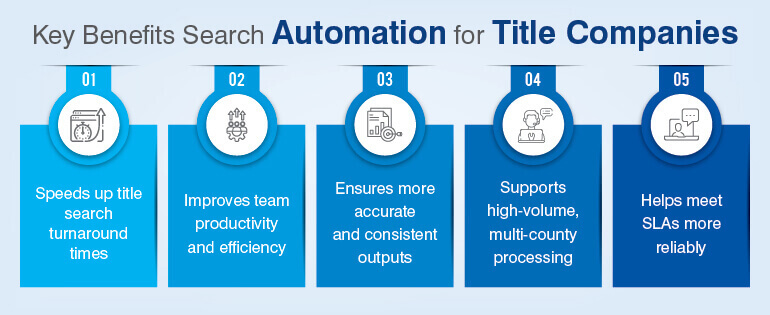
One of the biggest benefits of automation is faster title search turnaround time. This helps title companies prepare title commitments more quickly and improve closing timelines.
Automation also helps teams process more orders without adding large amounts of staff. That means better productivity and fewer operational bottlenecks.
AI-powered workflows apply the same extraction and validation logic across records. This helps improve consistency in title reports.
Automation makes it easier to handle multi-county and high-volume title search workloads. This becomes especially valuable during busy market cycles.
Faster and more reliable workflows help title companies meet service-level agreements more consistently. That leads to better customer satisfaction and stronger operational performance.
Still, automation works best when combined with human expertise rather than replacing it completely.
The future of title search is not fully manual or fully automated. It is a hybrid approach that combines AI-driven efficiency with human expertise.
“Technology and artificial intelligence are helping the title industry become more efficient, and our members are embracing those innovations. But resolving issues in a property’s ownership history still depends on professional expertise.” – Chris Morton, CEO, ALTA
Automation can speed up workflows, but human expertise is still essential. Title examiners are needed for legal interpretation, exception handling, and risk analysis. Complex title defects often require professional judgment.
In many cases, human reviewers validate AI-generated outputs before final reports are completed. This helps reduce risk and improve compliance.
As transaction volumes increase, managing title searches manually becomes harder to scale. Title professionals spend significant time on tasks such as:
To improve efficiency and handle larger workloads, modern title companies are adopting AI-powered technologies such as OCR, NLP, and ML.
Automation helps streamline workflows, while title professionals continue to focus on:
Ultimately, the most effective title workflows combine automation with human expertise to improve speed, scalability, and accuracy without compromising quality. But of course, adopting automation also comes with a few practical and operational challenges.
While title search automation offers major benefits, there are still a few challenges companies need to address. Let’s discuss some of the key factors that can impact adoption and implementation.
One of the biggest automation challenges is inconsistent county data. Every jurisdiction stores records differently, which makes standardization difficult.
Many title companies still rely on older production systems. Integrating modern AI platforms with legacy infrastructure can take time and resources.
Automation systems also require ongoing training and optimization. Models need to adapt to different document types, layouts, and county-level variations.
For many organizations, moving from manual workflows to digital title search operations requires process changes and employee training. This transition can take time.
That’s why following the right implementation approach becomes extremely important for modern title companies.
To get the best results from title search automation, companies need a balanced approach that combines the right technology, workflows, and human oversight. Let’s dive into the best practices for modern title companies below:
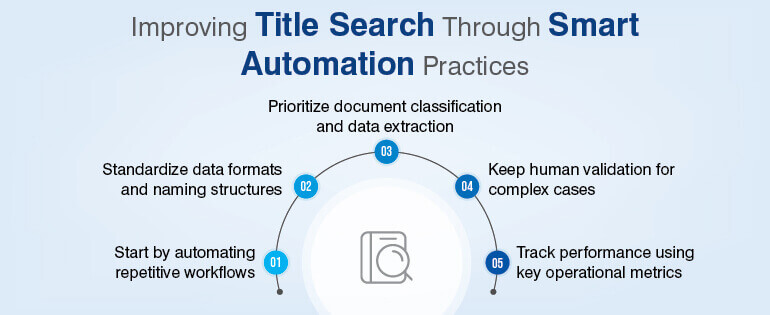
Instead of replacing everything at once, start by automating complex workflows first. This makes adoption easier and reduces operational disruption.
Consistent naming conventions through data normalization and metadata improve automation performance.
AI data extraction and document classification are usually the best starting points for automation. These tasks consume a large amount of manual effort.
Human review remains important, especially for complex searches and high-risk cases. Title companies should monitor metrics such as:
These insights help measure automation performance over time. As automation adoption continues to grow, the future of title search is evolving rapidly.
The future of title search is becoming more digital and AI-driven.
More counties are moving toward digital record systems and API-based data access. This will make property records easier to retrieve and process.
At the same time, AI systems are becoming more advanced.
In the coming years, title companies may see:
Even as technology improves, human expertise will continue to play an important role in legal review and exception handling.
Manual title searches have supported the title industry for decades now. But growing workloads and tighter turnaround expectations are making traditional workflows harder to manage.
Automation is helping title companies work faster, improve consistency, and handle higher order volumes more efficiently.
Still, the future is not about replacing title professionals with AI.
The real value comes from combining automation with human expertise.
When AI handles complex tasks and title experts focus on validation and risk analysis, title companies can build faster, smarter, and more scalable operations for the future.
What’s next? Message us a brief description of your project.
Our experts will review and get back to you within one business day with free consultation for successful implementation.

Disclaimer:
HitechDigital Solutions LLP and Hitech BPO will never ask for money or commission to offer jobs or projects. In the event you are contacted by any person with job offer in our companies, please reach out to us at info@hitechbpo.com