
How Chain of Title Works – Tracing Property Ownership Through County Records
 Aug 24th, 2026

Processing property records used to take hours of manual review. Today, AI can read, understand, and extract valuable data from real estate documents at a scale that helps teams work faster and make better decisions.
Table of Contents
Are you also doubtful about AI’s accuracy for reading and processing property records?
Extracting information from real estate documents was a slow and manual task for years. County records often exist as scanned PDFs, old paper files, or image-based documents. And even the records are filled with legal language, faded text, stamps, and handwritten notes.
Today, AI and automation are changing that.
The shift is happening at scale. Venture investors poured $16.7 billion into PropTech in 2025, a 67.9% year-over-year increase, with AI-centred firms growing at an annualized rate of 42%, almost double the pace of non-AI competitors (CRETI / Bisnow, 2026).
JLL’s Future of Work Survey 2024 found that 90.1% of companies plan to run their corporate real estate function with AI and technology supporting human experts, and 61% are already piloting different use cases (JLL Spark). Property data extraction is one of the workflows where adoption is moving fastest.
At the technical level, this shift is being driven by three core technologies working together. OCR converts scanned records into readable text. NLP interprets the legal language and clauses. Machine learning models classify documents and extract structured fields like owner names, APNs, legal descriptions, mortgage information, and recording dates from deeds, liens, tax records, and other property documents.
But none of this is straightforward in practice. County record formats vary widely, scan quality is often poor, and document structures stay inconsistent across jurisdictions.
These are the friction points where AI-driven property data extraction has to prove itself, and they are worth understanding before any platform commits to a workflow.
The problem starts with inconsistency. County property records aren’t uniform, and that makes it difficult to reliably extract structured information.
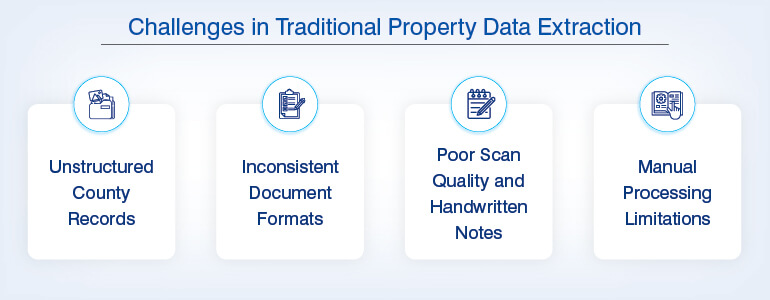
One of the biggest problems with property records is that they are highly unstructured. There is no universal format that every county follows.
For example, a deed recorded in Florida may look completely different from one recorded in Arizona or New York. Even within the same county, document layouts can change over time depending on how records were filed or digitized.
That means important information like owner names, APN numbers, legal descriptions, or recording references may appear unstructured.
Traditional extraction tools struggle with this type of inconsistency but AI models for automation are trained to adapt to those variations.
Real estate records are available in many forms, and each document type has its own structure. Deeds, mortgages, liens, judgments, easements, and tax records all look different.
Some documents are neatly formatted with clear sections and tables. Others are dense blocks of legal text with stamps, handwritten notes, or overlapping information.
This creates a challenge for automated systems because they cannot rely on fixed templates alone. AI driven extraction systems solve this by analyzing both the text and the document layout together.
If you have ever looked at older county records, you already know how messy they can be. Some scans are blurry, faded, tilted, or partially cut off. Others contain handwritten comments scribbled across the margins.
70% of public records at the county level are digitized, according to ALTA. A significant portion of property data still exists in older, inconsistent, or image-based formats that are difficult to process manually.
These issues make property information extraction much harder. A traditional OCR engine might completely miss critical details if the scan quality is poor.
Modern AI systems are much better at handling these situations because they use image enhancement and handwriting recognition models to improve readability before extraction begins.
Manual data entry might work for a small number of records, but it isn’t enough to process thousands or even millions of documents.
It is also easy for human reviewers to miss information or interpret legal language differently. Over time, these inconsistencies can create problems in title research, underwriting, and property databases.
AI helps reduce those bottlenecks by automating complex tasks while keeping extraction more consistent across large datasets.
With those friction points named, the next question is which document types AI can actually handle and what gets extracted from each document.
Explore the range of real estate records modern AI can analyze.
One of the biggest advantages of modern AI systems is their ability to process different types of real estate documents, not just standard deeds. AI can extract valuable property information from large volumes of unstructured records much faster than manual review.
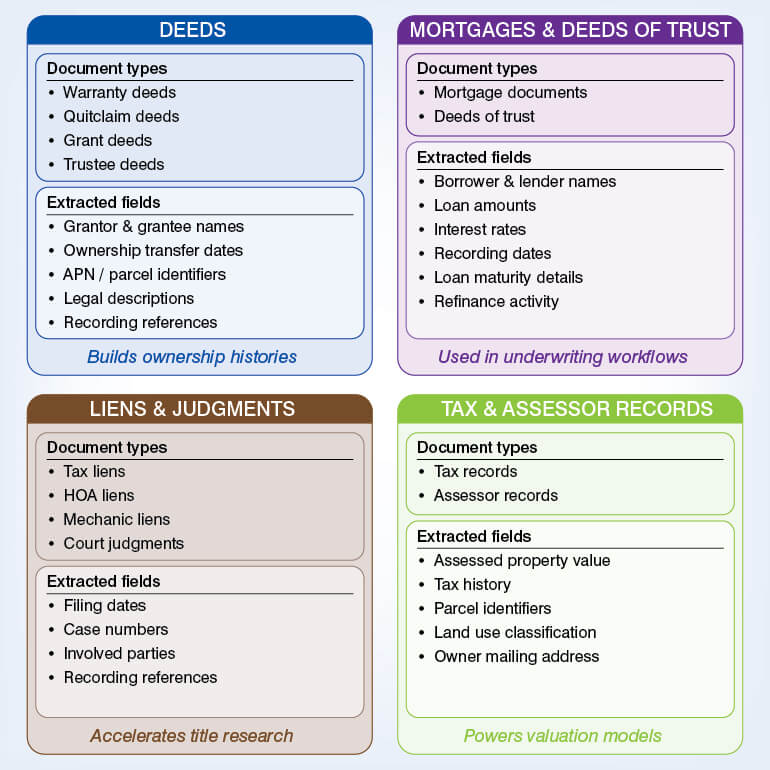
With all the above document types in mind, the next question is how AI actually reads all of this.
OCR, or Optical Character Recognition, helps AI convert scanned files and images into machine readable text. Since many county records are stored as PDFs or image-based files, OCR is the first step in automated property data extraction.
OCR systems identify printed text, numbers, and symbols from scanned records and turn them into searchable digital content that AI models can process.
Older records often include handwritten notes, signatures, and annotations. Modern AI models can recognize handwritten text with much higher accuracy than traditional OCR systems.
AI enhanced OCR tools improve extraction quality using techniques such as:
These improvements help increase accuracy even when scan quality is poor. But the text alone is not enough because it still needs to be understood before use.
Once the text is extracted, Natural Language Processing helps AI understand the meaning and context behind the information.
Property records contain complex legal terminology and formal language. NLP models help identify ownership transfers, mortgage obligations, liens, easements, and foreclosure related information.
AI systems analyze how clauses and sections connect to each other so they can understand the context instead of simply extracting isolated text fields.
NLP models can identify relationships between parties involved in a transaction, helping create ownership timelines and transaction histories.
AI systems can also identify and standardize key filing details, including:
From here, the focus shifts to the models that actually structure and classify this information.
AI property extraction relies on multiple machine learning models working together to process complex records accurately.
Before extraction begins, AI systems first identify the type of record being processed. This helps apply the correct extraction workflow automatically.
NER models identify important property related data such as:
This converts unstructured text into organized property data.
Layout aware models analyze visual structure, including tables, headings, signatures, and stamps. This improves extraction accuracy across inconsistent county record formats.
Even the best models hit a wall when they encounter the next problem: every U.S. county records property data differently.
One of the hardest parts of real estate document processing is dealing with county level variation.
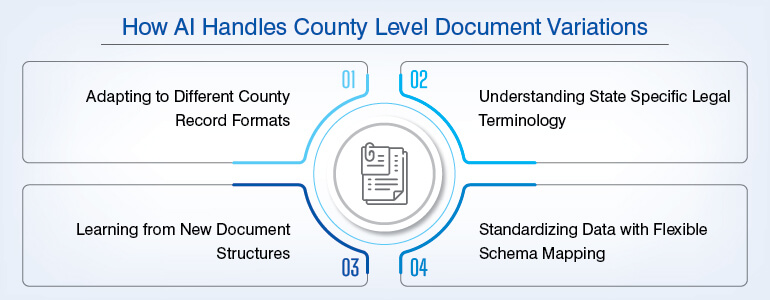
Every county recorder’s office has its own formatting standards, filing systems, and recording layouts.
AI systems need to be flexible enough to process these differences without relying on rigid templates.
Legal terminology also changes across states. Some states primarily use deeds of trust, while others use mortgages.
AI models trained on regional differences can better interpret those variations.
Modern AI systems continue learning as they process new documents.
The more county records they analyze, the better they become at handling unfamiliar layouts and terminology.
Leading property data aggregators have built their entire business model around solving the county-level variation problem. ATTOM Data Solutions applies a 20-step process to validate, standardize, and enhance every property record, with coverage now spanning 158+ million properties across 3,000+ U.S. counties. Each property carries a persistent ATTOM ID that lets clients track it across datasets.
“As AI reshapes how organizations operate and compete, our mission is to deliver analytics-driven, AI-ready property data that serves as the foundation for everything from large-scale market models to advanced geospatial applications.”
– Rob Barber, CEO, ATTOM Data. RISMedia, March 2026
The pattern is consistent. Property data platforms that scale successfully invest heavily in normalization infrastructure. The AI extraction work that this article describes is the engineering layer underneath that infrastructure.
Even though county records vary widely, the final output still needs to follow a consistent structure.
Schema mapping helps normalize extracted information into standardized property datasets.
With the variation problem addressed, the next layer of the pipeline is about trust. How do AI systems know when their extraction is reliable, and what happens when it’s not?
Even advanced AI systems need quality control checks to maintain accuracy.
AI extraction platforms assign confidence scores to extracted fields based on how certain the model is about the result.
If confidence is low, the field can automatically be flagged for review.
Human reviewers still play an important role in validating difficult or high-risk records.
Instead of reviewing every document manually, teams only focus on records that need extra attention.
Some records naturally require more scrutiny, especially foreclosure filings, bankruptcy related documents, and complicated ownership transfers.
59% of title professionals identified securing releases for prior mortgages as the most significant curative challenge, according to ALTA. Missing or unresolved mortgage releases can delay transactions and require extensive manual verification.
AI systems can identify these records and route them through enhanced workflow verification.
AI property data extraction is not just about speed. It changes how real estate teams work with information, from reducing manual effort to improving data quality at scale.
Instead of spending hours reviewing county records, AI can process thousands of documents in a very short time. What once took days can now be done in minutes, which is a big advantage for teams handling large property datasets.
Manual review often leads to small inconsistencies, especially when dealing with complex legal documents. AI applies consistent logic across all records, which helps improve overall data reliability.
Do you really want skilled teams to spend time copying data from documents? AI removes most of that repetitive work, so teams can focus on analysis, exceptions, and decision making instead.
Whether it is thousands or millions of records, AI systems can scale without adding a proportional manual workload. This makes it much easier to manage multi-county property data extraction at scale.
These benefits become concrete when you trace where the extracted data actually ends up.
Once property data is extracted and structured, it becomes much more useful across different real estate workflows.
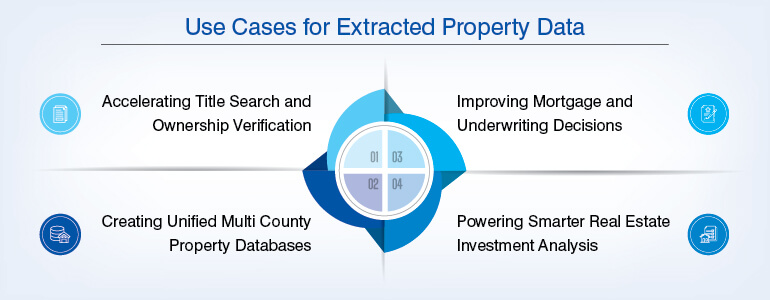
Instead of manually digging through records, title teams can quickly find ownership history, liens, and key filing details in a structured format.
Lenders use extracted data to verify ownership, check mortgage history, and assess property related risk during underwriting decisions.
Real estate platforms rely on AI extracted data to build large searchable property databases by combining records from multiple counties into a single system.
Investors use structured property data to track trends, analyze transactions, and identify potential investment opportunities more quickly.
The institutional shift is already underway. Deloitte’s 2025 GenAI in M&A Survey of 1,000 senior investors found that 86% of corporate and private equity firms have adopted generative AI in their M&A workflows. 88% of private equity firms have invested $1 million or more in GenAI for M&A use cases (Deloitte, 2025). Property data extraction sits at the centre of that workflow because the underwriting, due diligence, and portfolio analytics teams all depend on it.
What makes this even more interesting is how quickly the technology behind it is evolving.
The market context is shifting fast. The global PropTech market is projected to grow from $40.19 billion in 2025 to $88.37 billion by 2032. The AI in real estate market specifically is forecast to grow at a 30.5% compound annual growth rate through 2033, reaching approximately $41.5 billion (CRETI, 2025 Emerging Trends in PropTech). Property data extraction is one of the highest-leverage AI use cases driving that growth.
In fact, what we see today is just the starting point. The next wave of systems will not only extract data but also understand, reason, and interact with property documents in much more intelligent ways.
So what is coming next, and why does it matter for real estate teams?
Large Language Models are already changing how AI systems work with legal and property documents. Instead of just pulling fields from a record, these models can:
This makes property data feel less like raw extraction and more like a conversation with the document itself.
Imagine asking, “Who owned this property over the last 20 years?” and getting a clear, structured answer instantly.
Real estate documents are rarely clean or simple. They often include stamps, signatures, handwritten notes, tables, and messy formatting.
Multimodal AI brings all of this together by analyzing:
Instead of treating these elements separately, multimodal systems understand them as one complete document.
This leads to better accuracy, especially for older or poorly scanned county records.
AI property data extraction is transforming how real estate records are processed. By combining OCR, NLP, ML, and document understanding, it turns unstructured county records into clean, structured, and searchable data at scale.
Now the question is, how much time could your team save if property data was already extracted, cleaned, and ready to use?
And what would change in your workflow if title search, underwriting, and property analysis became faster and more automated?
The teams running real estate data platforms, REIT portfolios, and PropTech products are already operating at scale that manual extraction cannot match. AI-driven property data extraction is the engineering layer that makes that scale possible, and the gap between platforms that have built it and platforms that have not is widening every quarter.
What’s next? Message us a brief description of your project.
Our experts will review and get back to you within one business day with free consultation for successful implementation.

Disclaimer:
HitechDigital Solutions LLP and Hitech BPO will never ask for money or commission to offer jobs or projects. In the event you are contacted by any person with job offer in our companies, please reach out to us at info@hitechbpo.com