
What is Title Search: Process, Challenges, Automation and AI Best Practices
 Oct 5th, 2026
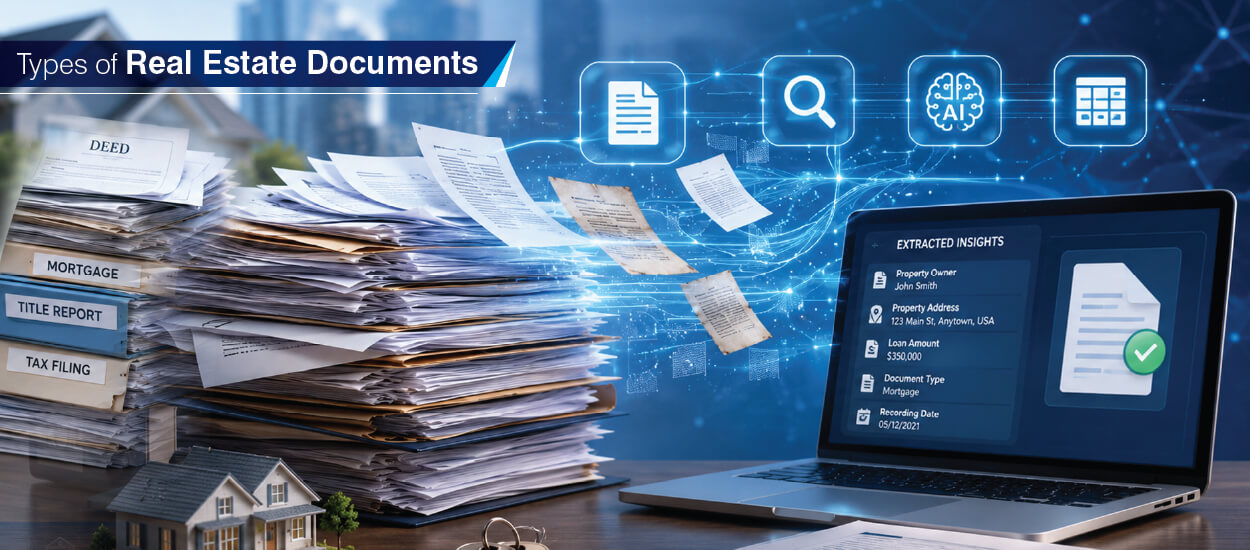
Real estate documents establishes property ownership, reduces liens risks and ensures legal compliance. OCR and NLP convert these documents into accurate, structured data for easier access and analysis. Data standardization improves operational efficiency, supports automation, and enables decision-making.
Table of Contents
Imagine buying a property only to discover a hidden lien or ownership dispute. How can you avoid costly surprises?
The answer lies in the list of real estate documents.
Deeds, mortgages, title reports, and tax filings hold the truth about ownership and financial obligations. Most are unstructured, scattered across counties, and hard to read.
For investors, lenders, and proptech companies, tools like OCR for real estate documents, NLP for property documents, and AI for real estate document processing turn messy records into reliable, analytics-ready data.
This blog explains the lifecycle of real estate legal documents and how automation is changing real estate transaction documents.
Let’s explore more…
The foundation of property ownership in the United States lies in the public recording system which is managed at the county level.
The recording process follows three key steps:
This system enables transparency and ensures that property ownership documents in the USA are legally enforceable and publicly verifiable.
So now that we understand how the recording system works, let’s dive into the different types of real estate documents you’ll run across.
Before learning about the importance, let’s learn more about the categories of real estate documents in the USA.
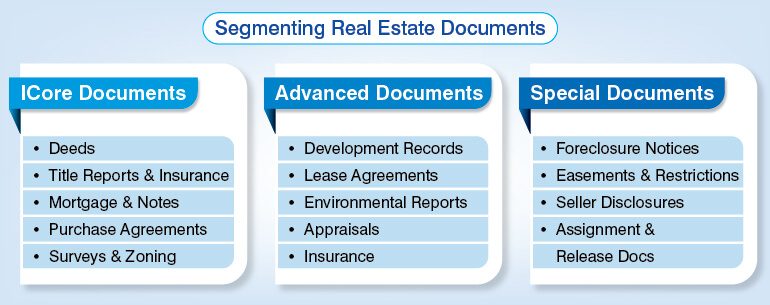
These are the most critical real estate legal documents that establish ownership.
These documents directly enable ownership transfer.
Together, these validate ownership history and reduce risk. Title report and survey documents are often used during due diligence.
These secure the lender’s financial interest in the property.
These are core real estate transaction documents governing the deal structure.
These ensure regulatory compliance and define property boundaries.
Additional documents become relevant depending on property type and use:
Some documents are frequently overlooked but highly important:
Now that we know the types of documents, let’s see why they are so important for property transactions and ownership security.
Real estate documents provide legal proof, protect financial interests, and support informed decisions. They play vital role in:
Understanding real estate legal documents is key to protecting ownership, reducing risk, and enabling smooth transactions.
Let’s follow these documents through their full lifecycle to see how they are used in practice.
Use AI to quickly identify ownership, risks, and key details.
Understanding the lifecycle helps in organizing and processing property documents list efficiently. Here is the process:
| Stage | Key Documents / Activities |
|---|---|
| Pre-Transaction |
|
| Transaction Phase |
|
| Financing Stage |
|
| Post-Closing |
|
Not all documents carry equal weight. Listed are the important ones:
With the lifecycle clear, it’s necessary to know what key data we should extract from the important documents.
To build analytics-ready systems, it is essential to extract data from real estate documents accurately.
| Data Category | Key Elements |
|---|---|
| 1. Ownership Data |
|
| 2. Property Data |
|
| 3. Financial Data |
|
| 4. Transaction Data |
|
Next, let’s look at how modern technology helps extract and process it efficiently.
Modern ML and AI-powered systems rely on:
This enables automated property data extraction from both structured and unstructured sources.
A robust data extraction pipeline in real estate generally includes:
This process converts structured vs unstructured property data into usable formats. Once data is extracted, standardization and validation become crucial to ensure it is accurate and usable.
Automate data capture from deeds, mortgages, and title records.
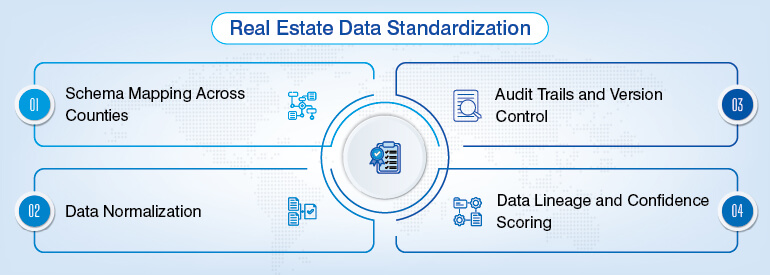
U.S. property records are majorly fragmented, often recorded at the county level with varying formats and standards. The key practices for data standardization include:
So, schema mapping property data to a unified schema ensures consistency across regions and enables easier comparison, aggregation, and analytics.
It keeps property records consistent for accurate reporting and risk assessment.
This is crucial for compliance, troubleshooting discrepancies, and verifying the integrity of processed data.
This helps ensure that the data is reliable and can be used for decision-making.
Confidence scoring allows users to prioritize high-quality data for critical analysis.
Implementing these governance practices ensures that real estate data is structured, reliable, and ready for AI-driven workflows.
Now, let’s look at how we can ensure that the property data we collect is accurate and error-free.
Accuracy is paramount while processing real estate documents throughout the USA, as errors can lead to financial, legal, or compliance risks. A robust validation and property data quality assurance framework generally involves:
Ensuring consistency across related documents such as deed versus title or mortgage versus lien records. Conflicts are flagged to prevent errors in ownership verification or risk assessment.
Standardizing property addresses ensures consistent location mapping, reduces duplication, and supports geospatial analyses.
Identifying and merging duplicate records prevents inflated datasets and maintains accurate transaction histories. Compliance with all other regulations.
Proactively detecting gaps in key fields like owner names or parcel IDs early. Then fix them to ensure the data is complete and reliable.
With proper validation in place, the next step is to be aware of the legal framework and compliance requirements that govern real estate data in the U.S.
The U.S. real estate ecosystem operates under multiple regulatory layers. Each of them defines how documents must be recorded, reported and maintained:
Compliance with all levels of regulation, including disclosure requirements and lending laws, is mandatory. Failure to comply can lead to legal disputes, financial penalties, or invalidated transactions.
While compliance sets the rules, the U.S. real estate market presents hurdles that make data management a bit complex. Let’s check out in the next section.
Validate, standardize, and manage real estate records across counties.
Even with growing digitization, several challenges make processing property documents in the USA complex. Here are the common ones:
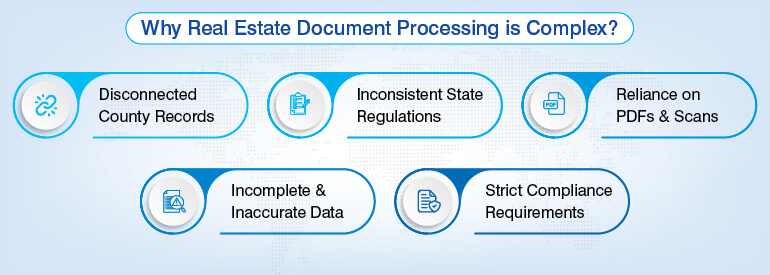
Each county may use different software, formats, and filing procedures, creating inconsistency and integration challenges.
Legal requirements and document types differ from state to state, requiring careful adaptation of extraction and validation processes.
Scanned images and PDFs make automated data extraction difficult, needing OCR and NLP tools.
Missing fields, inconsistent naming, outdated information or poor data quality can lead to errors in ownership verification, lien analysis, or financial assessment.
Rules for disclosure, privacy, and record retention can restrict access and processing, adding complexity for data-driven solutions.
Efforts in county records digitization are improving accessibility, but the ecosystem still remains fragmented. Addressing these challenges requires robust pipelines, governance, and advanced automation tools.
Despite these obstacles, automation in real estate documentation offers a clear path to reduce errors, and scale operations effectively.
Adopting real estate document automation improves efficiency, reduces errors, and enables better decision-making. Key benefits include:
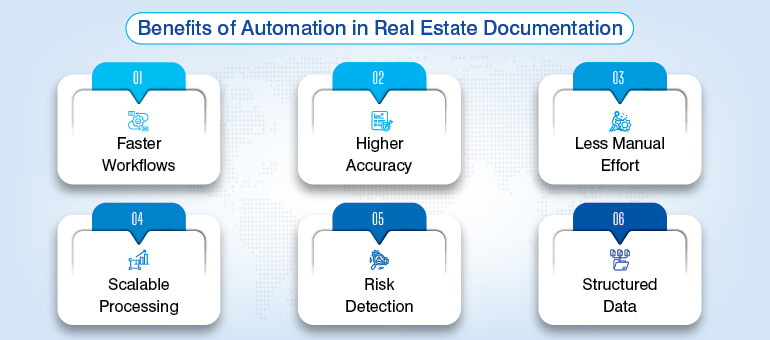
Automation reduces human errors, especially when capturing details like ownership, property descriptions, and financial data.
Tasks that used to take hours can now be done in minutes, helping speed up property transactions.
Routine tasks like sorting documents and entering data are automated, so teams can focus on more important work.
You can process large volumes of records across multiple counties without increasing effort.
Systems can quickly spot issues like missing data, liens, or ownership mismatches.
Data is captured in a uniform way, making it easier to analyze and use for reporting.
Understanding the advantages of automation naturally leads us to real-world applications where these tools are already making an impact.
Modern AI for real estate document processing is already being used across the real estate and lending ecosystem:
According to McKinsey‘s “State of AI” survey (Nov 2025), companies are investing more in AI to create bigger impacts. Many are spending a large part of their digital budgets on AI, showing that its use is expanding beyond just pilot projects.
These applications are helping organizations move from manual review to data-driven decision-making. Next, let’s look at how to handle real estate documents efficiently using these tools.
To manage real estate documents efficiently, organizations need a structured planning that combines consistency, compliance, and automation. Here are the best approaches:
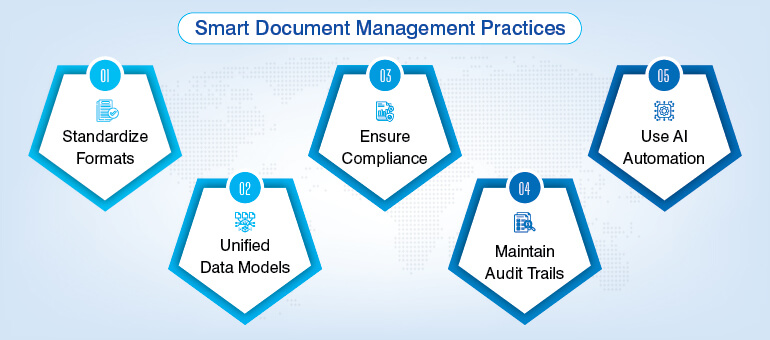
Since real estate documents come from multiple sources and in varying formats, it’s important to bring uniformity across them.
Use consistent templates and naming conventions for documents like deeds, mortgages, and leases. Convert files into structured formats using OCR and normalization tools to simplify processing.
Because data varies across counties and states, having a common structure is essential for consistency.
Create a unified data model for property details, ownership, and transactions. This ensures smoother integration across systems and better data management.
Given the strict regulations in the real estate industry, compliance must be built into every step of document handling.
Follow federal, state, and local requirements for storage, recording, and data privacy. Regular updates to processes help keep everything aligned with current laws.
To ensure transparency and trust, every document change should be properly tracked. Maintain version history, timestamps, and user activity logs.
Validate data throughout the workflow to ensure accuracy and make audits or dispute resolution easier.
As document volumes grow, manual processing becomes inefficient and error-prone. Use AI to automatically identify document types, extract key data, and route files through the correct workflows.
This improves efficiency and reduces manual effort over time.
Finally, let’s see how technology is shaping the future of real estate documentation.
Real estate paperwork is changing fast. Technology is making it easier, faster, and safer to handle documents for buying, selling, and managing property. Below listed are some of the future trends.
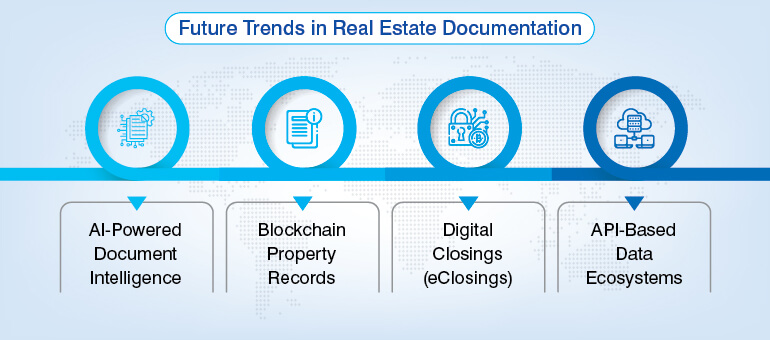
AI can now do more than just read documents. It can spot mistakes, link information about buyers, sellers, and lenders, and even give helpful insights so decisions are smarter and faster.
Blockchain is like a digital ledger that cannot be changed. It makes it easier to verify who owns a property and reduces the chances of fraud or disputes.
You no longer have to sit through piles of paperwork. E-signatures and online notarization let people complete closings digitally. This saves time and makes the process much simpler.
Different systems now talk to each other. APIs let lenders, title companies, and government offices share property data instantly, so everything moves more smoothly without delays.
The global Property Technology (PropTech) market is projected to be worth USD 47.39 billion in 2026 and grow to USD 83.01 billion by 2030 at a 15% CAGR.
Real estate documentation in the U.S. is essential but can be complex. Going digital with AI, OCR, and automated tools makes handling them faster and easier.
Organizing, standardizing, and using smart technology is the only key to staying competitive in today’s real estate market.
Are you ready to take control of your real estate documents and make your processes smarter?
What’s next? Message us a brief description of your project.
Our experts will review and get back to you within one business day with free consultation for successful implementation.

Disclaimer:
HitechDigital Solutions LLP and Hitech BPO will never ask for money or commission to offer jobs or projects. In the event you are contacted by any person with job offer in our companies, please reach out to us at info@hitechbpo.com