
How Chain of Title Works – Tracing Property Ownership Through County Records
 Aug 24th, 2026
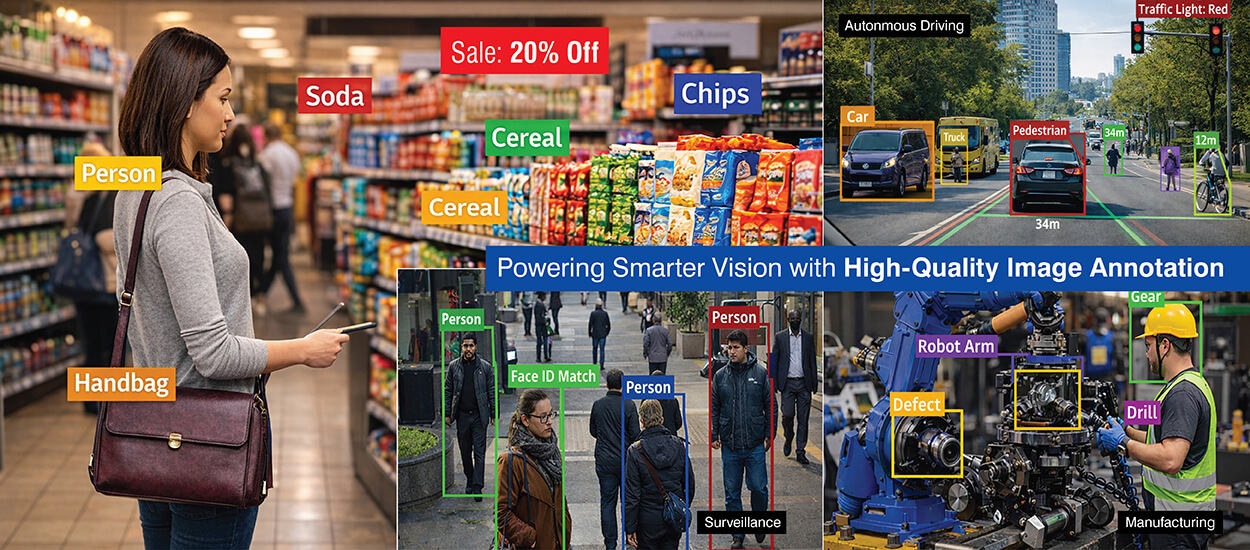
High-quality data provides the basis for building efficient and accurate computer vision applications. It requires strong and precise image annotation process that helps data scientists to train models effectively. Growing complexity and high data volumes is a challenge but when used effectively, image annotation improves model performance.
Table of Contents
High-quality image annotation forms the basis of effective computer vision models. Accurate and clean labels reduce noise and false positives and help models perform acceptably in real world situations.
We use image annotation techniques to translate raw images into structured training data that teach the needed recognition patterns to the models. Techniques like object detection, image classification, image segmentation etc. help models to identify and locate objects in an image.
Data may not be the only foundation of effective computer vision models, but it plays a huge role. You cannot make image-based AI applications work without proper image annotation.
In the sections ahead, we have discussed in detail 5 powerful ways image annotation influences your computer vision models.
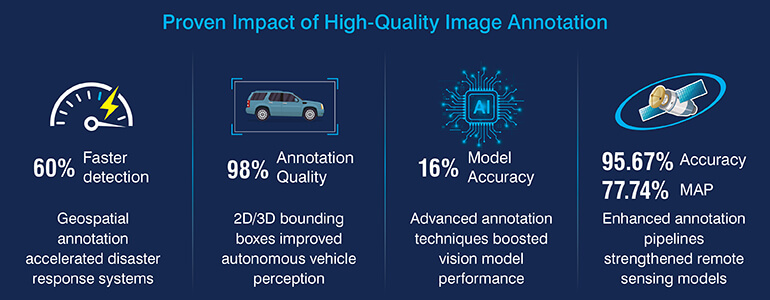
The principal role of Image Labeling in AI is to transform raw images into training data that models can understand and interpret accurately.
When you label an image with metadata it helps a machine to recognize objects or patterns in images. The models get trained to recognize objects like cars and traffic signs when labelled, and it helps autonomous cars to navigate with object detection.
This is especially helpful in retail, where training with bounding boxes around products allows models to identify misplaced items or stock levels in retail stores.
Often in complex cases, especially in medical scans, we need pixel-level labels and image labelling allows for pixel-level understanding.
Image labelling also plays a good role in identifying defects and quality control. Manufacturing industry use this in a big way. It gets easy to detect dents or cracks using annotation.
Image labelling helps handle complexities with ease and accuracy. In short image annotation for computer vision helps with accurate decision making, reduces errors, improves contextual understanding, reduces bias and works as a great foundation for accurate AI models.
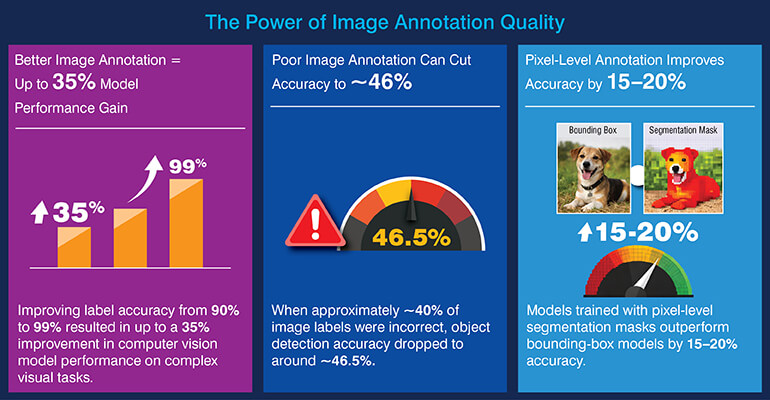
Image annotation helps models to understand images accurately for building reliable computer vision models. Accurately annotated images reduce ambiguity and gives machines the clarity to interpret visual data. Here are five powerful ways how image annotation strengthens computer vision models and real-world performance.

Image annotation in AI helps models in object detection. Annotation techniques in computer vision like bounding boxes, masks and polygons helps identify objects clearly. The models don’t confuse objects with backgrounds or any kind of overlapping as the object boundaries get well defined. Minutely annotated objects allow for accurate detection in any situation, be it low light, or any kind of clutter.
Bounding boxes, polygon annotation, keypoint annotation or instance segmentation masks are some of the image annotation techniques that helps with training data for vision AI models. All these techniques help capture irregular object shapes, mark object landmarks and shows pixel level differentiation.
Industries like autonomous vehicles, surveillance or retail platforms benefit immensely from image labelling. It helps in pedestrian detection in high traffic areas, finding products for shelf monitoring and inventory management, signal detection for navigation etc.
Improve detection precision of your computer vision model
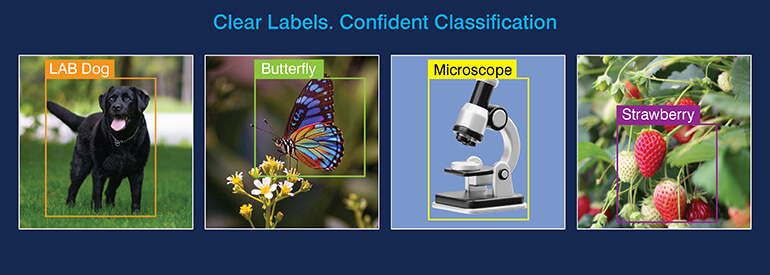
Image annotation strengthens classification by teaching models what truly differentiates one class from another. Image classification helps machines understand the category and is needed to start any advanced tasks. It gets easy for the models to understand the category and visual patterns. So, when a new image is thrown in front of the model, the model can easily predict the category based on past training.
Image annotation is different from object detection, which identifies where objects appear. Techniques like image-level labelling assigns a primary category to each image while tagging captures features or secondary characteristics.
With image classification, models become more accurate and efficient at identifying what an image represents. They can reliably determine whether a medical scan is normal or shows abnormalities, or classify images based on context such as indoor or outdoor, day or night. It enables faster decision making and is a great support for industries such as healthcare, retail, agriculture, manufacturing, and security.
Image classification helps models to differentiate categories that look similar, reduces training cycles and drives reliable predictions. It also reduces ambiguity between similar classes. It is widely used in healthcare diagnostics, e-commerce, and agriculture monitoring systems.
Want to improve image classification of your models?
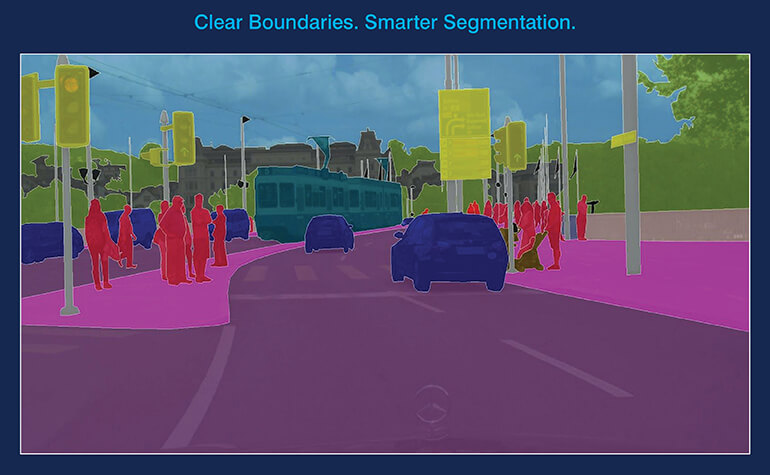
This technique helps AI models with accurate object understanding that reduces bias and strengthens model fairness. Semantic segmentation assigns a class label to every pixel in an image which could be car, building or animal. Instance segmentation further separates objects from the same class. Pixel accurate boundaries help with reduced noise and ambiguity.
This helps computer vision models in many ways. Apart from faster learning and accurate object understanding the model makes less mistakes in crowded areas improving safety in critical systems.
To understand with examples, this involves separating vehicles, pedestrians, road, pavement, lane markings in a street scene. This helps the models to understand the scene better avoid any hurdles and perform reliably in autonomous driving systems. In case of diagnostics segmenting tumors in medical scans help in treatment planning.
Now if you are into ecommerce then isolating products from backgrounds supports visual search, and in construction or manufacturing, this would extend to detecting cracks or defects.
High-quality semantic and instance segmentation gives computer vision models pixel-level clarity, enabling accurate understanding, decision-making, and real-world deployment.
Get pixel-level accuracy to improve computer vision outcomes
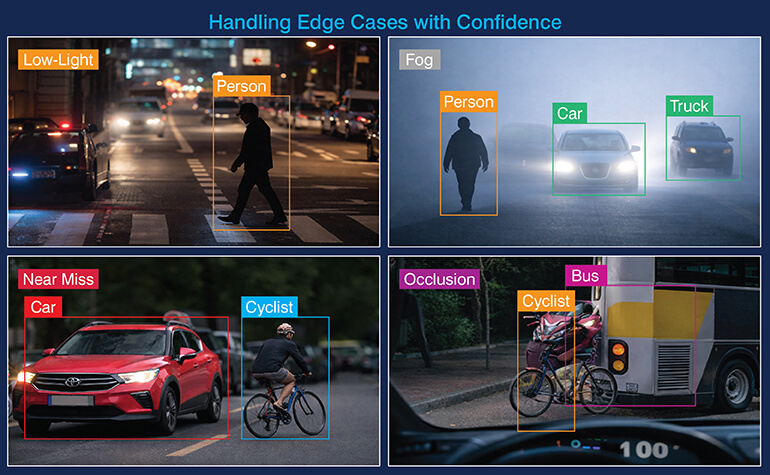
So far, we have talked about accurate object detection, pixel level annotation but sometimes the situation is not always perfect. The models need to function reliably even in rare cases like lighting variation, occlusions or unusual patterns. This is where image annotation plays a role. It improves model robustness for edge cases.
It expands the model’s visual coverage where low frequency scenarios are well represented in the training data. Say, for autonomous driving models, if the situation changes to fog or heavy rain or say night glare, then the models should be able to learn and act accordingly. So, annotation of pedestrians done in such conditions help models identify people beyond daylight conditions.
This also reduces any kind of doubt in ambiguous visual signals. Often visual cues are weak and that time there is a probability of models getting confused. Here precise labels help models with clarity. Like if there are some overlapping objects such as people in a crowd and stacked products, then instance masks for such overlapping objects help models separate both.
Edge-Case Robustness especially supports industries like healthcare, autonomous driving, security, manufacturing and retail. You must invest in image annotation for improved feature learning for rare patterns, prevent any kind of bias and increase stability in variable conditions.
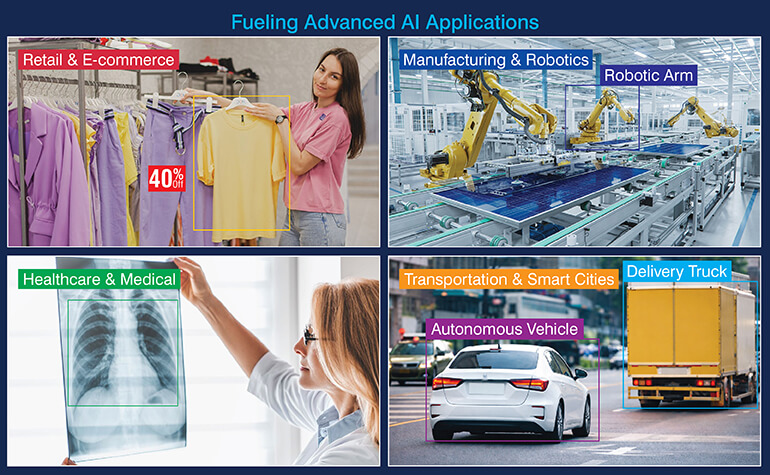
Annotation techniques in computer vision helps AI application to recognize complex scenes, identify objects accurately as they convert raw visual data into structured, machine-readable data. From autonomous driving to retail analytics and medical imaging, annotated data trains models to interpret visuals accurately unlocking automation, safety, and smarter decision-making at scale.
It helps machines understand intent and context, not just object recognition. Rich annotations like relationships, attributes etc. train models not just on identifying the objects but also why it matters. It helps machines go much beyond the basic recognition. Like autonomous driving annotation is not limited to just pedestrians but also pedestrians standing or crossing the road.
It also delivers high precision and domain specific training embedding expert knowledge directly into training data. This helps machines operate at high-grade accuracy. In healthcare, pixel-level tumor boundaries and staging annotations encode clinical expertise that enables AI to support diagnosis, not just flag anomalies.
Image annotation is the key to advanced AI applications, enabling systems to understand visuals deeply, act reliably in real-world conditions, and scale across industries.
Looking for a custom labeling workflow for your projects?
Image annotation enables computer vision systems to work efficiently, but it is also one of the most challenging phases of the entire pipeline. The quality, scale and complexity need to be addressed. Here are few challenges that need to be addressed.
Most important is managing annotation accuracy because even a small labelling error can mislead models impacting model prediction accuracy. Handling complex scenes like poor lighting, overlapping objects etc. also makes it extremely difficult to define boundaries. Any kind of mismatch here and the whole AI model can go for a sixer.
AI models often require huge volumes of annotated data and the volumes often fluctuates. Keeping the ability to scale without quality degradation is another challenge that annotators face. Managing edge cases that are often underrepresented is critical, as they strongly influence real-world model robustness. Handling rare edge cases requires skill and expertise.
Finding domain expert is another challenge, which is essential for specialized applications like healthcare or autonomous driving. These fields demand annotators with subject knowledge.
And finally, managing quality to ensure annotation correctness requires multiple review layers, increasing time and operational complexity. Also, faster annotation often risks lower quality, while high precision increases cost and turnaround time. Balancing cost, speed and quality is a challenge that needs expert handling.
Outsourcing image annotation is a strategic move to manage your labelling and computer vision models efficiently. Your internal or core team can focus on model development, and the image annotation part can be handled by the external experts.
Specialized partners are well equipped with the advanced annotation techniques and have the ability to handle projects of any domain and complexity. This reduces burden on the internal team and also offers speed and cost efficiency. You get faster turnaround time, save on money, and don’t have to worry about any scalability issues.
Look for a partner who has the expertise in your relevant field, check for credibility and ability to handle edge cases. And most importantly ensure that there is a balance between quality and cost, not just low pricing.
Image annotation is the biggest foundation needed for training AI-based computer vision models. Almost every computer vision model needs structured data created by human annotators. Each image in your training data must be accurately labelled so that AI systems can detect objects accurately, understand the context and intent so that any kind of bias or ambiguity can be avoided.
The higher the quality of your annotations, the better your AI models can perform. Now since the volume and complexity of images are growing every day your annotation techniques must be updated. Domain experts are also absolute necessity to meet the growing annotation challenges. Plan your annotation projects well and keep your team and tools updated all the time. And look for partners who can help you with annotation so that you focus on your core task.
What’s next? Message us a brief description of your project.
Our experts will review and get back to you within one business day with free consultation for successful implementation.

Disclaimer:
HitechDigital Solutions LLP and Hitech BPO will never ask for money or commission to offer jobs or projects. In the event you are contacted by any person with job offer in our companies, please reach out to us at info@hitechbpo.com