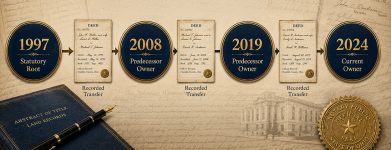
What is Title Search: Process, Challenges, Automation and AI Best Practices
 Oct 5th, 2026
PRIA and MISMO are the two core frameworks standardizing U.S. property record and mortgage data across 3,100+ counties. Together with AI-powered document processing, they enable compliant, scalable real estate data pipelines – reducing errors, cutting costs, and accelerating title and loan workflows.
Table of Contents
In the United States, there isn’t one singular property database. Rather, over 3,100 county recorder offices are responsible for storing property records as well as their own unique data formats, legacy systems and indexing methods.
Ice mortgage technology encompasses all of the above county recorder offices, housing more than 600 million ownership, sale, assessment and mortgage records. More than 500 million real estate and loan transactions have been documented and processed through 2690+ counties via ATTOM. The sheer size of this represents potential; however, the fragmented nature of this structure presents a significant obstacle to teams developing new real estate data platforms or integrating multiple sources into pipelines.
At the center of the property data standardization solution are two standard framework groups: PRIA (Property Records Industry Association), and MISMO (Mortgage Industry Standards Maintenance Organization). Understanding which areas both govern, how they differ from one another, and where they cross-reference will provide foundational knowledge to all organizations working toward standardization of property data.
Property record data standards establish an agreement as to how real estate data should be formatted, titled, exchanged and verified amongst disparate systems and organizations.
PRIA is a not-for-profit corporation developed by joint effort of governmental agencies and businesses to develop national standards and best practices for the land records industry. Members of PRIA include county recorders, title companies, lenders, notary associations, and technology providers.
PRIAs primary focus has been developing standards for documentation in the Document recording segment. These standards establish guidelines for:
Although there appears to be an increase in the number of jurisdictions adopting PRIA’s standards, they appear to be generally inconsistent. In support of this statement, The Kentucky County Clerks Association officially accepted PRIA’s formatting standards effective January 21, 2020. Maricopa County also accepts PRIA’s file format standards as part of their eRecording agreement. However, many jurisdictions continue to utilize legacy systems which do not natively produce compliant PRIA formatted XML output.
MISMO is a not-for-profit subsidiary of the mortgage bankers’ association consisting of over 175 member organizations. MISMO establishes a universal language for the exchange of data throughout the entirety of the mortgage lending cycle: origination, servicing, delivery to secondary markets and real estate services.
All major US Mortgage regulators and GSE require the utilization of MISMO standards. Studies have demonstrated that the use of MISMO standards results in reduced per-loan costs, fewer errors and accelerated processing time by removing manual, paper-based processes from loan originations. Version 3.6 of the MISMO reference model was approved for Candidate Recommendation status on May 11, 2023 and expanded coverage to appraisal data exchange, private label RMBS due diligence, closing instructions, and the MISMO API toolkit.
| Dimension | PRIA | MISMO |
|---|---|---|
Scope |
County recording & document indexing |
Mortgage origination, servicing & secondary market |
Core unit |
Recorded instrument (deed, lien, assignment) |
Loan/mortgage transaction |
Primary users |
County recorders, eRecording vendors, title companies |
Lenders, servicers, GSEs, compliance platforms |
Data model |
Document-centric (XML schemas for recording metadata) |
Transaction-centric (Reference Model with hierarchical containers) |
Key outputs |
Indexed recording data, eRecording submissions |
ULDD, iLAD, UCD, UAD — loan delivery datasets |
Governance |
Joint government-industry not-for-profit |
MBA subsidiary; collaborative workgroup process |
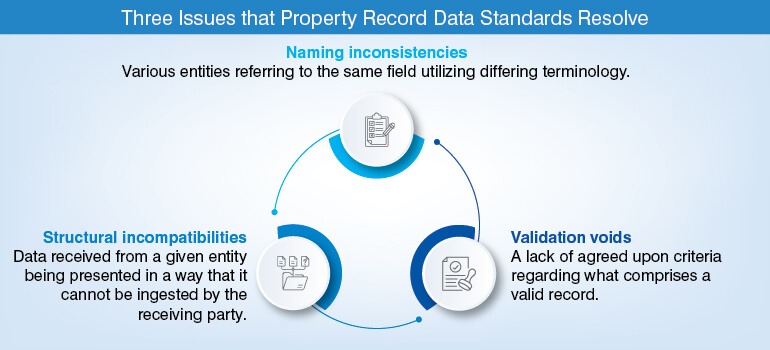
Uniform sets of standardized property records will always include uniform field names and definitions across each county or system. As such, when organizations implement a solution for standardizing real estate data, these are the core field definitions which must be uniformly extracted, normalized and validated in order to ensure reliable downstream usage:
Much of the united states’ property record is currently stored as scanned pdfs, handwritten legal instruments, and legacy images. Intelligent document processing (IDP), powered by optical character recognition (OCR), natural language processing (NLP), and more recently Large Language Models (LLMs) is required to convert this unstructured content into structured PRIA or MISMO data.
Over 80 to 90 percent of digital information is unstructured, therefore IDP is a requirement for any meaningful efforts to standardize property data. Traditional OCR transforms images of written words into machine readable character strings. Modern AI-powered IDP builds upon traditional OCR, NLP property documents by recognizing context within a document, determining the type of document, and extracting specified fields based on document layouts that can vary greatly among the thousands of local county formats.
There is a clear performance argument for utilizing AI driven IDP in the commercial real estate space:
Once the extracted data aligns with PRIA and MISMO schema definitions, then the extracted data is not simply digital but it is now standardized and ready for input into title workflows, loan systems and compliance platforms without requiring additional manual conversion.
Although there exist standards, aligning property data across multiple US jurisdictions continues to be challenging.
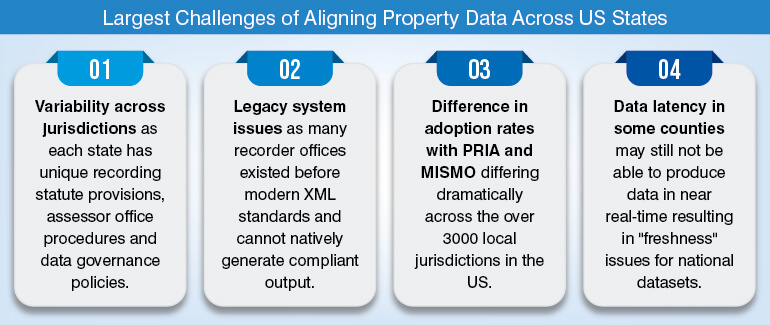
The main engineering responses to schema mapping real estate data and data normalization are to create standardized schemas from varying county formats and to implement transformation rules so that output can be validated consistently at large scales.
Data governance has to exist in conjunction with the afore-mentioned functions: field level validation rule implementation, cross source reconciliations of assessor & recorder data, and duplicate identification & update frequency tracking. These are functional requirements for an entity who maintains standard property datasets across multiple state jurisdictions.
Without these functional components, even a very good mapped schema will deteriorate rapidly as the source data is changed.
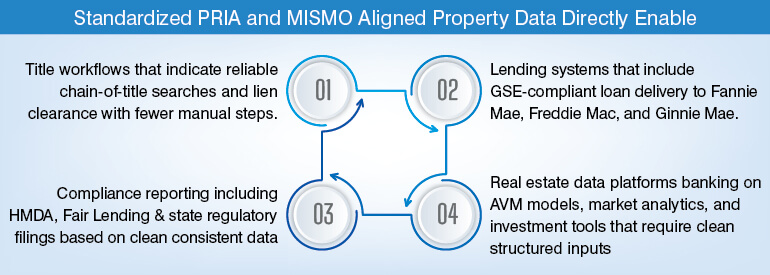
MISMO has developed an API toolkit as part of its version 3.6 reference model and is delivering centralized digital closing criteria through modern API services including county recording requirements counter party readiness and title under writer restrictions through their e- eligibility exchange.
AI/LLM document structure and real time recording pipelines are being made possible by growing e-recording adoption which will allow for near real-time PRIA-compliant property data at national scale for the first time in history. Competitive advantage belongs to those that move from batch ingestion of data to event driven pipelines anchored within standards compliant schemas.
PRIA & MISMO are not bureaucratic formalities. These are connective infrastructure on which scalable automated & compliant solutions built around real estate data can be constructed.
PRIA defines what a well indexed county recording looks like while MISMO defines common mortgage and lending data exchanged between parties. Companies implementing both and developing governance process to maintain quality across multi-state environment build real estate data platform capabilities that are faster more interoperable and better positioned for the automated transactions that are becoming industry standard. Companies treating these standards as operational infrastructure rather than compliance check boxes, will be the ones that could scale without friction.
PRIA and MISMO are not optional compliance checkboxes. They are the foundational infrastructure that separates scalable real estate data platforms from fragile, patchwork systems.
With over 3,100 county recorder offices operating on inconsistent formats and legacy systems, organizations that treat standardization as a strategic priority, not an afterthought and gain a measurable competitive edge. Those that layer AI-powered Intelligent Document Processing on top of PRIA and MISMO frameworks unlock the ability to convert unstructured records into clean, machine-ready data at national scale.
The next wave belongs to teams that shift from batch data ingestion to event-driven, standards-compliant pipelines. Whether you’re building a title workflow, a loan origination platform, or a multi-jurisdictional property database, PRIA and MISMO are the common language your systems need to speak and now is the time to become fluent.
What’s next? Message us a brief description of your project.
Our experts will review and get back to you within one business day with free consultation for successful implementation.

Disclaimer:
HitechDigital Solutions LLP and Hitech BPO will never ask for money or commission to offer jobs or projects. In the event you are contacted by any person with job offer in our companies, please reach out to us at info@hitechbpo.com