
What is Title Search: Process, Challenges, Automation and AI Best Practices
 Oct 5th, 2026

AI models trained using corrupted, unrepresentative, or leakage-contaminated data fails in production. Your model learns the noise and the duplicates in your training set and generalizes those errors to live inference. Adhering to data preparation steps directly gates the quality of training data to prevent this failure.
Table of Contents
Imagine your AI model showed 96% accuracy in the training phase but failed miserably in production within weeks. Hyperparameters were tuned perfectly and architecture was really sound. So then why did it fail? The problem is the use of biased, unrepresentative, and contaminated data in the training loop. And this has not happened with you only. Instead, it is the most common and preventable failure in machine learning projects.
Data preparation is exactly what sets your AI model for success or failure. Anaconda’s State of Data Science surveyed 3,493 practitioners across 133 countries to conclude that data scientists spend an average of 37.75% on data preparation and cleansing. This is not their core task, but to ensure the model succeeds they have to do it.
Your AI model learns the right patterns only if it is fed clean, well-structured, representative data. Feed it noisy, incomplete, or biased data and it will not only learn wrong things but will carry those errors into every prediction it makes during production. This makes data preparation important for developing successful AI models.
Other reasons that make data preparation important for developing AI models include, your model cannot correct for label errors used to train it, your model is not capable of generalizing to demographics that were not included in the training datasets, neither can your model compensate for leaked feature information across the train-test boundaries.
All of these are not model problems. These all are data problems and they should be addressed upstream before initiating the training process.
Attributes that operate within a ceiling set by data quality include model architecture, hyperparameter tuning, and inference optimization. Disciplined data preparation approach will help you raise the ceiling if you are looking to make downstream ML decisions more reliable.
Most enterprise ML pipelines don’t fail because of weak models. They failed because the data infrastructure behind them was not built to support production-scale preparation.
The ten data preparation steps for machine learning encompasses ten stages. Starting right from defining scope of data problem to auditing data sources, and cleaning, validation, feature engineering, and annotation, to versioning and pipeline governance.
Each of the ten steps in a sequence below are backed by tools and techniques that determine whether your model will generalize or not.
Before your team starts collecting or cleaning any data, you should lock the task definition. Their first step should be to define the problem of scope and identify data requirements. They might come up with the question as to why data requirements must precede data collection.
And the answer to the question is that classification, regression, object detection, named entity recognition, time-series forecasting and several others will inflict various requirements on data modality, volume, label granularity, and acceptable ground truth ambiguity.
Defining the problem scope and data requirements will help you come up with three documents:
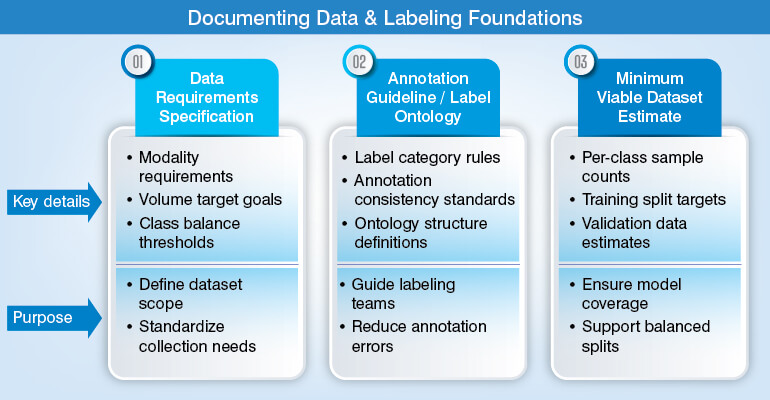
No AI teams can afford to skip this step. Doing so may lead your teams to realize that bounding box annotations required semantic segmentation masks, or the regression target should have been treated as ordinal classification. At the same time, you cannot afford to rebuild a labeling schema once the annotation is complete proves to be a really expensive error in an ML pipeline.
However, if the requirements are defined and locked, it will help in evaluating candidate data sources against the specifications locked. Your teams will no longer have to adjust specifications to match whatever data is available.
Data sources for ML projects include proprietary databases and open repositories like Hugging Face Hub, UCI ML Repository, Kaggle. Also, web-scraped corpora and synthetic generation pipelines like diffusion models, & GANs are also important.
And yes, don’t forget to add third-party data annotation service providers or third party data annotation partners to the list. It might look lucrative, but each of them carries distinct risk profiles, warranting source auditing.
At this stage, the source audit will evaluate three things:
Three data collection pitfalls that surface later when your AI model fails
Adhering to this step will not give you a dataset. But it promises you that all the data you collect will be sourced and audited with authentic documentation. This matters the most when you are stuck and want to trace a model’s performance regression to a specific data intake batch.
Up till now we defined the scope of problem, basis which we also decided which and how to evaluate data sources for bias, coverage, and licensing. So, it’s time we discuss data profiling and exploratory data analysis. Yes, the distributions, correlations, and outliers that are the determinant to which data cleansing strategy should select.
The very first thing that we need accept is that data profiling and exploratory data analysis – EDA are meant for two different purposes, so do not conflate.
You can use data profiling for automated schema and statistical summarization of null matrices, dtype inference, value frequency histograms, cardinality counts. Using tools like ydata-profiling, Sweetviz, and D-Tale will help you generate these HTML reports in less than minutes.
At the same time, exploratory data analysis – EDA, is analyst-driven investigation. It mainly supports you to determine cleaning and transformation activities like:
Why missingness pattern classification changes everything?
Missingness pattern classification is a fundamental concept in data analysis. Missing data is rarely random. Missing data more than often carries its own signal which is systematically related to unobserved factors. Ignoring these signals will result in biased, inaccurate, or misleading results.
Missing data, though a negative aspect, is very critical to know everything about it. We can classify the missing data in three categories:
| Missing Data Type | Definition Highlights | Example Scenario | Key Implication |
|---|---|---|---|
| MCAR: Missing Completely at Random |
|
|
|
| MAR: Missing at Random |
|
|
|
| MNAR: Missing Not at Random |
|
|
|
Why missingness pattern classification is important for data profiling?
Understanding the “Why” behind missing data is extremely important for data profiling and EDA activities.
Your Data preparation teams can use Apache Spark and BigQuery ML to expose equivalent profiling functions at distributed scale when working with too large datasets. They can also use Google’s PAIR Facets tool for interactive slicing of training data distributions across categorical dimensions. It will help them in identifying subgroup representation gaps before cleaning.
Till now we learnt and read about what to do, and so now we will see how to choose the right strategy for missing values, noise, and duplicates.
Your data professionals can execute and implement all the EDA findings in this very crucial step of data cleansing. The problems of missing values, duplicate records, and noisy labels or features should be handled distinctly. For imputing missing values match the strategy to the mechanism.
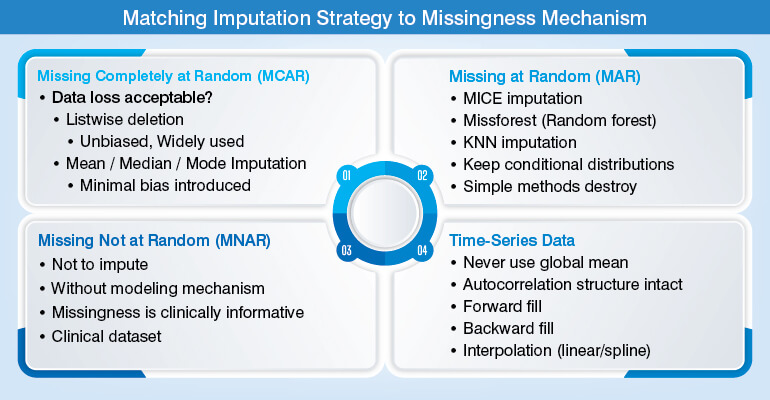
Why exact match is not enough for deduplication?
You can use hash-based exact deduplication to handle identical records. And for near-duplicate removal you can use fuzzy methods like MinHash LSH for text corpora, Levenshtein distance for short strings, and of course perceptual hashing for images. If you inflate near-duplicates in the training set, it will eventually improve the training metrics and degrade generalization. Do not confuse evaluation gain with model improvement.
Why label noise is a ceiling problem?
Label noise is not an edge case. On average 3.3% of errors were identified when 10 of the most commonly used computer vision, natural language and audio datasets were inspected. Also, 2916 label errors comprise 6% of the ImageNet validation set. You can go ahead and use confident learning algorithms to identify putative label errors; and then validate them using human-in-the-loop approach.
According to Journal of Engineering and Artificial Intelligence 60% asymmetric label noise on CIFAR-10, ResNet-18 test accuracy dropped to 38.7% with Expected Calibration Error exceeding 35%.
Experienced and expert data preparation service providers leverage confident learning to algorithmically identify likely label errors at scale. For subjective labeling tasks they deploy inter-annotator agreement scoring. For categorical labels they use Cohen’s kappa, and for ordinal they use Krippendorff’s alpha. It provides a quality floor before any model could see the data.
Once done with data cleansing, validate the data against schema expectations before you move it to transformation. Data cleaning and data transformation are two different data pipeline stages.
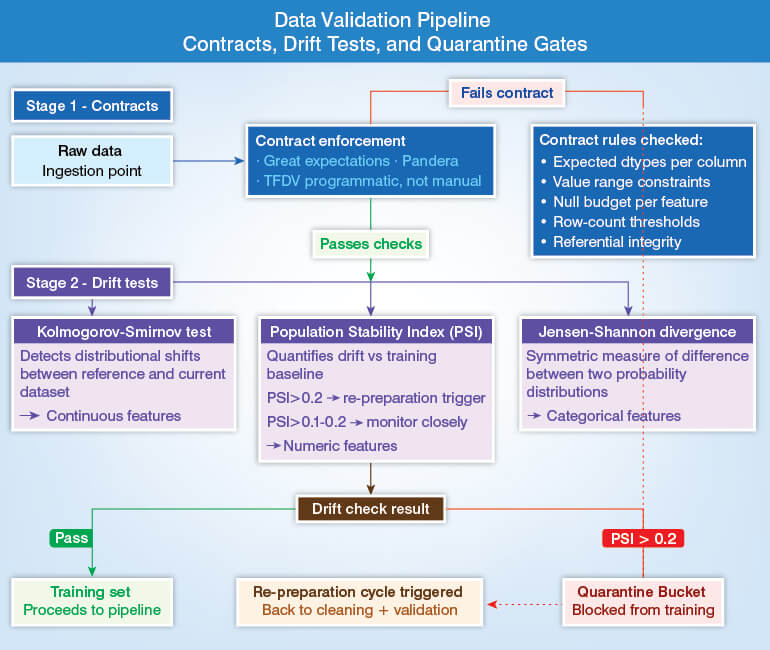
Data validation and schema enforcement; both these foundational techniques take care of data quality, consistency, and reliability across modern data systems. Though used together they serve individual roles in a data pipeline.
The process of data validation will operationalize your quality expectations as a code. As you know, manual spot checks are not scalable and also, they do not provide audit trails.
Operational implication of data validation and schema enforcement is very simple. Data that fails validation checks is routed to quarantine bucket. It should not reach the training dataset. This is the gate that prevents a corrupt batch of data from silently degrading a model which was working fine before it entered the workflow.
The next step, after data validation, is restructuring it into numeric representations which ML algorithms can consume. That’s where feature engineering and transformation enters the picture.
Feature engineering and transformation is all about scaling, categorical encoding, and building features without leaking information across splits. The process of converting validated data into numeric presentations is also critical because the choices made here will directly affect both; your model’s accuracy and the validity of your evaluation metrics.
Which models care in feature scaling?
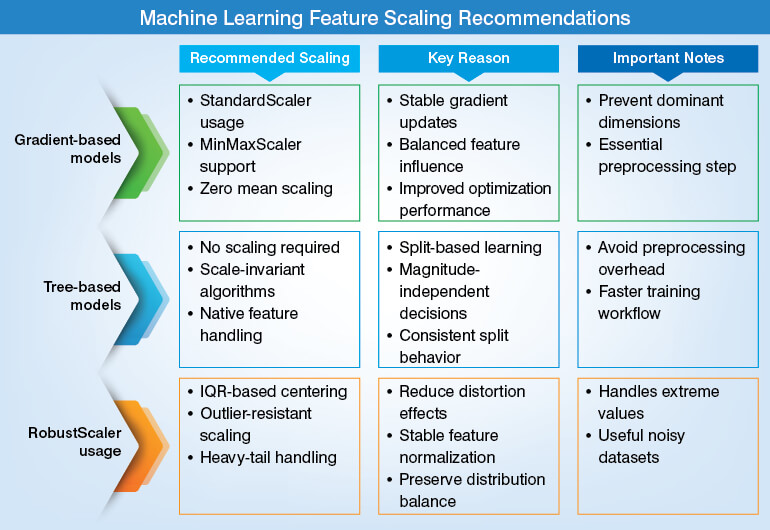
Feature scaling is a critical pre-processing step for ML models that calculate distances between data points or use gradient-based optimization. If you don’t scale features with different ranges (e.g., age vs. salary) it will make your model prioritize variables with larger magnitudes, and make it biased, inaccurate, and slow-to-converge.
How to match cardinality to method for categorical encoding?
In order to prevent overfitting, manage memory, and improve model accuracy matching the correct categorical encoding method to cardinality – number of unique categories, of a feature is mandatory. High-cardinality features can create standard methods like One-Hot Encoding for creating too many dimensions, while low-cardinality features may not capture complex relationships even while using advanced methods.
| Category Type | Recommended Encoding | Key Characteristics | Important Considerations |
|---|---|---|---|
| Low-Cardinality Nominals |
|
|
|
| High-Cardinality Nominals |
|
|
|
| Ordinal Categories |
|
|
|
How to prevent data leakage during feature engineering?
Data leakage is normal when all the available information at the time of interference is encoded in training features. Also, it can happen when a transformation fit on the full dataset is applied without splitting it. Both situations inflate evaluation metrics while guaranteeing production underperformance.
The mechanical solution to prevent data leakage during feature engineering is to wrap all transformations in a scikit-learn Pipeline or FeatureUnion. Ensure you fit the pipeline on the training split only. Start by applying transform only, not fit; on validation and test. Feature that encodes information from after the prediction is a leakage vector and must be dropped immediately.
Engineered features will amplify signals, but what will you do with datasets that contain hundreds of them. To prevent the mishap of dimensionality, dimensionality reduction and feature selection becomes mandatory.
There are three selection paradigms; filter, wrapper, and embedded methods, and you should know when to use which, as each of them optimizes for a different trade-off.
| Feature Selection Method | Common Techniques | Key Advantages | Important Limitations |
|---|---|---|---|
| Filter Methods |
|
|
|
| Wrapper Methods |
|
|
|
| Embedded Methods |
|
|
|
How to reduce dimensionality for unstructured data?
To reduce dimensionality for unstructured data like text, images and audio; transform high-dimensional raw data into lower-dimensional representations. Retain the essential information while doing this. Key techniques used to reduce dimensionality in unstructured data includes use of deep learning models (Autoencoders, CNNs) for feature extraction, embedding techniques (BERT, Word2Vec for text), and algorithms like PCA, t-SNE, or UMAP to compress high-dimensional vectors.
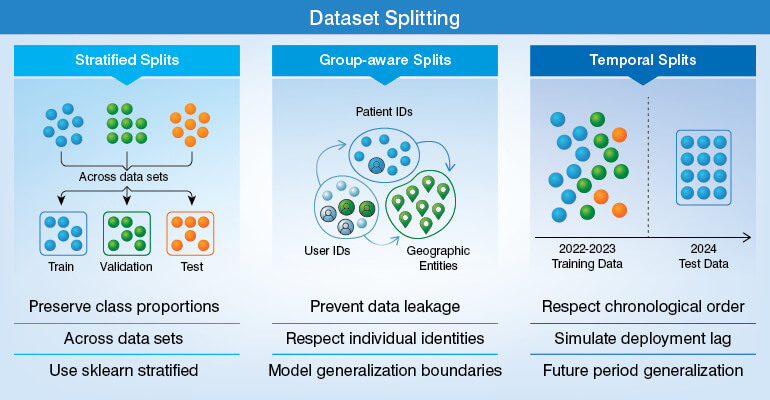
With a compact, informative feature set, the next decision that you would be making is how to split and sample the data; a stage where class imbalance should be addressed directly.
For an independent, identically distributed tabular dataset with balanced classes, you can go ahead and use the random 80/20 train-test split. However, chances that real-world ML datasets meet those conditions is very less.
Data analytics company serving government agencies partnered with Hitech BPO to prepare voluminous training data to be fed to their machine learning project. The final solution predicted traffic issues, prevented accidents, improved road planning, and assisted in civil engineering projects.
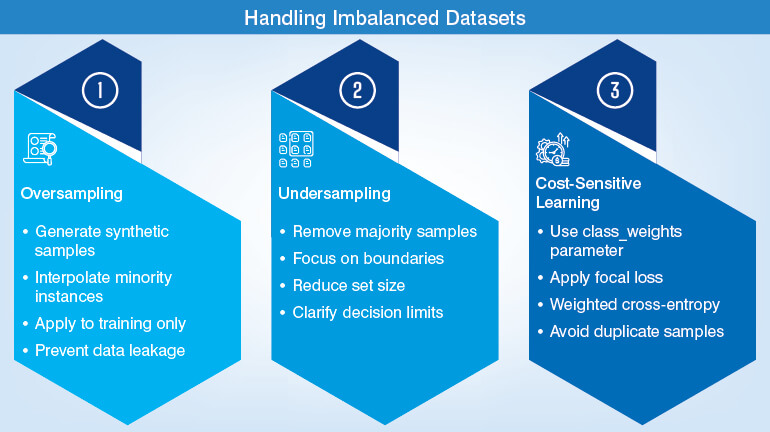
How to handle class imbalance without inflating your metrics?
Class imbalance causes standard accuracy which is misleading. A classifier predicts the majority class with 99% accuracy, 100% of the time on a dataset with 1% positive class prevalence. You can use Precision-recall AUC, Matthews Correlation Coefficient (MCC), and macro-average F1 which are considered to be the correct metrics for imbalanced problems.
Now that your training dataset is structured correctly check out on what it lacks for supervised learning. Yes, you guessed it right. It is reliable ground truth which makes accurate data annotation a necessity.
For supervised learning, high-quality annotation of your training datasets is the hard ceiling on model performance. No right or wrong choice of architecture, no hyperparameter tuning, and no augmentation strategy would help you recover accuracy lost due to systematic label errors. This is why inter-annotator agreement, and adjudication protocols belong in your pipeline specs.
It helps you to establish the ceiling principle where “if a model is trained on noisy labels, it should not generalize beyond the accuracy of those labels”. So, this way, a 5% label error rate should set the practical upper bound on test accuracy.
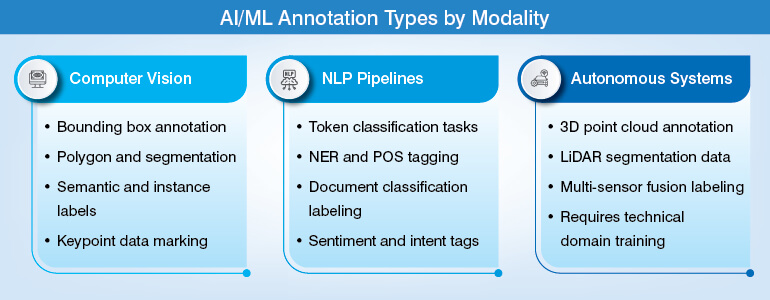
Annotation types vary by modality, and all of these demand annotators with domain-specific technical training.
A Swiss food waste management company partnered with Hitech BPO for accurate and timely training data preparation. It enhanced their ML models’ ability to analyze visual data effectively, supporting their mission to combat food waste in hotels and restaurants.
How to have a quality control process that catches annotator drift before it reaches training?
Having a fully annotated and validated training dataset is not the end of story. It will still need infrastructure to ensure that it remains reproduceable and auditable across model iterations. And to address it you need data versioning and pipeline governance.
Do you know that the same code on different dataset versions produces different models. Yes, that’s true. Dataset versioning is a prerequisite for model reproducibility. But, if you version the first two without versioning the third, it will make model reproducibility nearly impossible. The same code on v1 vs. v2 of a training set produces different models. Most AI and ML companies consider dataset versioning as an optional activity, instead they should consider it to be a MLOps hygiene practice, which is warranted for debugging production regressions.
To keep a track of datasets without duplicating large binary files in version control you can take snapshots by integrating Data Version Control – DVC with GIT. Every training run will tag a dataset version hash. It empowers you to reproduce the exact training set that produced it, just in case any of your model’s performance degrades during production.
Why use data lineage to trace what produced each dataset version?
Using data lineage is suggested as it records which raw sources, transformation steps and annotation runs produced each version of any dataset. Apache Atlas, MLflow, Weights & Biases Artifacts are the tools that implement OpenLineage metadata collection making the activity traceable and queryable. Plus, nowadays, for some regulated industries, lineage documentation has become a compliance item and not just a data engineering convenience.
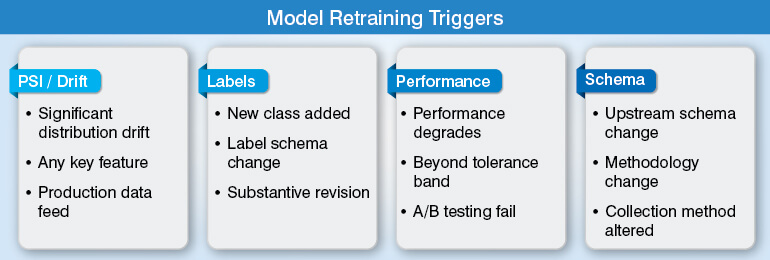
When to trigger a full re-preparation cycle?
Here, we have simplified the criteria into clear and concise bullet points for better understanding of one and all. It highlights indicators like significant distribution drift, revised label schemas, performance degradation, and of course upstream schema changes as well.
Which are compliance-specific governance requirements in preparing data for AI models?
How training data is stored, accessed, and destroyed have separate requirements when it comes to compliance to governance norms.
AI and ML companies should ensure to build these into the pipeline specification, and not as post-hoc overlays.
None of the 10 data preparation steps that we talked about in the article are independent tasks. They are a sequential pipeline, where the output of the previous step becomes the input of the next step. Cut down or skip any of the step, and the errors will propagate forward.
For AI teams working on large-scale, multi-modal, or regulated ML datasets, adhering to all 10 steps will require dedicated tools and technology, annotator infrastructure and a robust QC process that internal teams are rarely staffed with to manage and maintain end-to-end data preparation process.
What’s next? Message us a brief description of your project.
Our experts will review and get back to you within one business day with free consultation for successful implementation.

Disclaimer:
HitechDigital Solutions LLP and Hitech BPO will never ask for money or commission to offer jobs or projects. In the event you are contacted by any person with job offer in our companies, please reach out to us at info@hitechbpo.com