
AI for Title Search Automation: Definition, Process & Benefits (2026 Guide)
 Nov 2nd, 2026

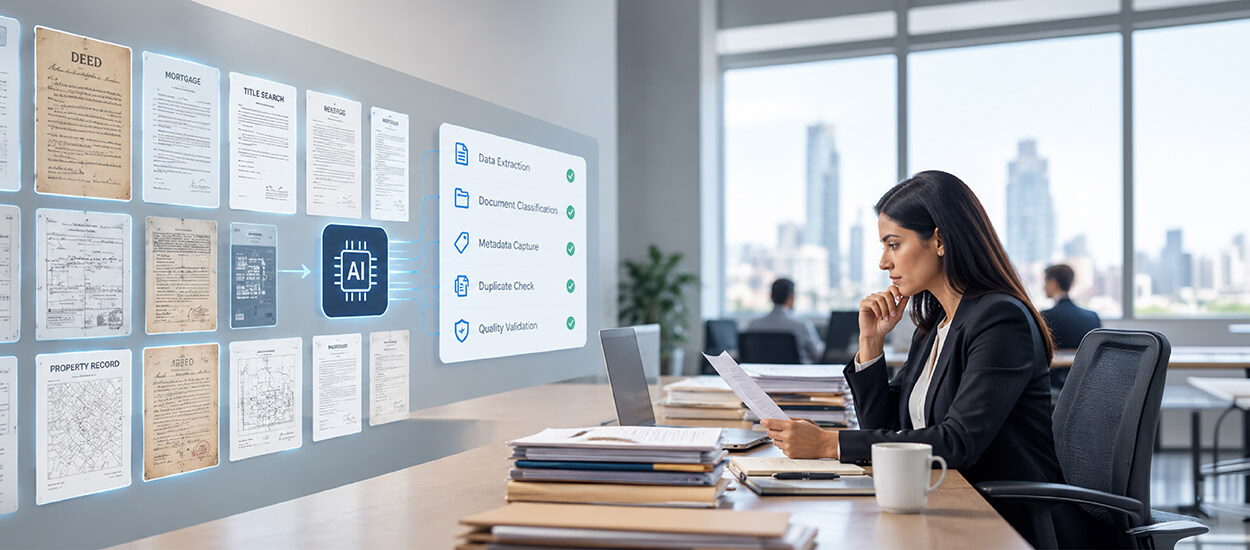
AI for title search automation compresses the data-heavy preparation stages of title production (ingestion, classification, extraction, chain assembly, and lien search) using OCR, NLP, and machine learning, with confidence scoring in title search and human-in-the-loop validation keeping results reliable.
Table of Contents
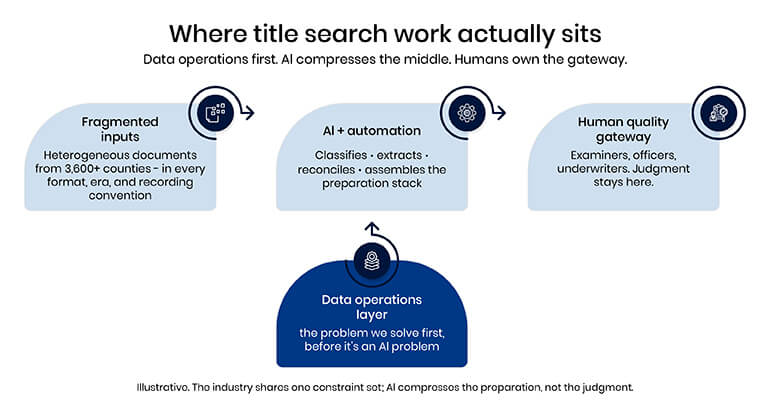
Title search still depends on a large amount of manual work, because county records are digitized unevenly. AI and automation can take over much of that data work. AI for title search automation hands over the automatable steps while humans keep the judgment calls.
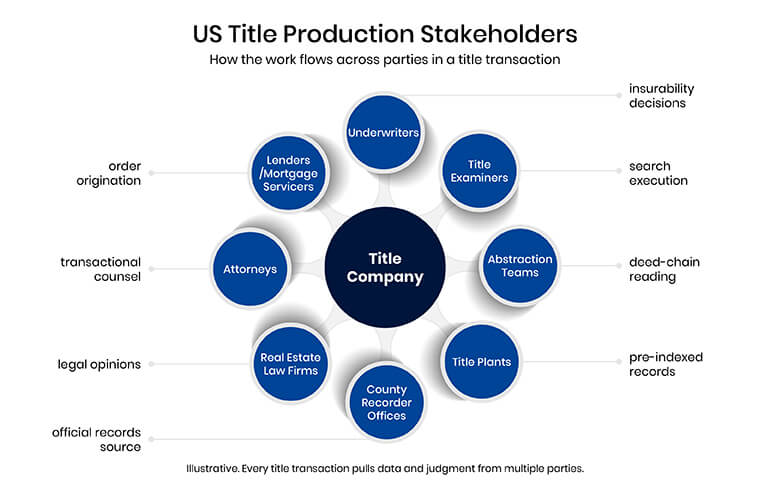
Title examiners, abstractors, real estate law firms, and the attorneys and underwriters who depend on clean titles remain the quality gatekeepers. For them, accuracy and risk control come first, and faster turnaround comes after.
ALTA reports that only 70% of county-level public records are digitized, and often only the past 10 to 15 years are online. Formats and indexing also change from county to county.
At the same time, title insurance premium volume rose 13.8% in 2025 to $18.5 billion, according to ALTA figures reported by Scotsman Guide. Rising volumes can lead to turnaround delays and pressure on examiner productivity if manual processes are not streamlined. Without documented county knowledge and automation, that knowledge can leave with experienced examiners when they retire.
AI for title search automation applies machine learning, natural language processing, and optical character recognition to the preparation stages of a title search. These are the data-heavy, repetitive steps that come before examination and underwriting decisions.
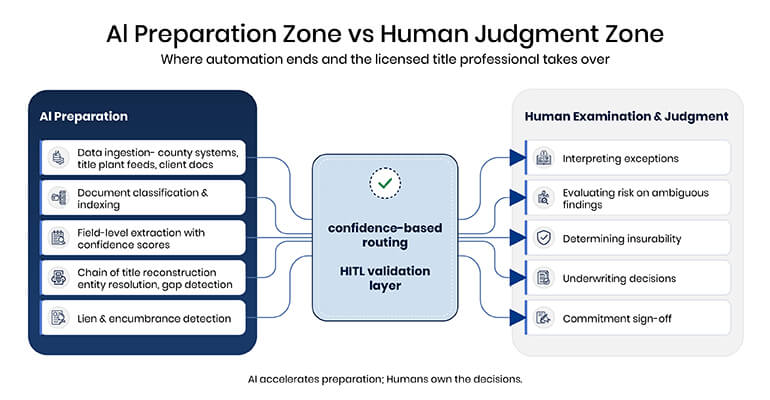
AI ingests recorded instruments from county systems and title plants. It then classifies and indexes them, extracts field-level data, rebuilds the chain of title, and flags exceptions.
In this model of title search automation, a person stays in the process. Human-in-the-loop validation reviews exceptions, critical fields, and any item that falls below a confidence threshold. With AI for title examiners, the examiner works from a pre-built, source-linked file and no longer assembles the data by hand.
Recording statutes differ by state. In race-notice jurisdictions, a later purchaser for value without notice takes priority only by also recording first. Pure race and pure notice statutes set priority by different rules.
Each county recorder office also sets its own indexing, document formats and public access, and where no title plant exists, searchers retrieve records from the county directly. Any automation has to be configured around these state and county differences, which the sections below address.
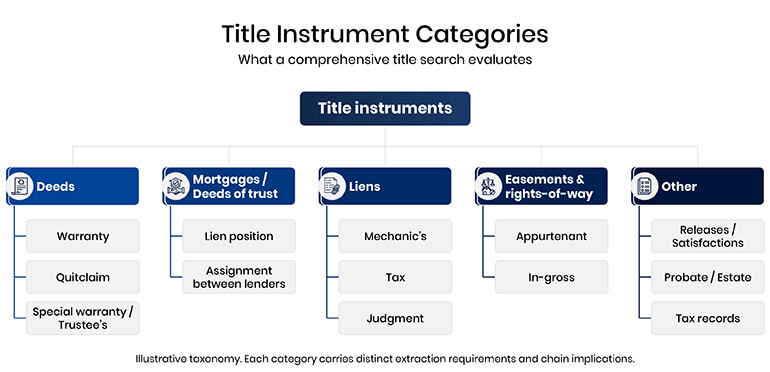
Search depth varies by product type. It sets how far back the chain goes, which exceptions matter, and which documents to pull.
A current owner search runs from the most recent vesting deed forward. It is common in refinances and HELOCs, where prior ownership history is already established.
Two-owner and three-owner searches extend back through prior acquisitions. Each extra owner adds documents and complexity.
A full search traces the chain from the root of title or back a set period, often 40 to 60 years, and the required period can vary by state and by underwriter. Because a full search usually takes the most labor, it is where preparation automation can save the most time. Update, rundown or continuation searches pick up filings recorded since an earlier search date.
Foreclosure searches cover lis pendens filings, default notices, and trustee’s or sheriff’s deeds. REO searches verify the chain from foreclosure to resale and flag subordinate interests that survived.
Tax and lien searches run on their own or inside broader searches to check payment status and the priority of recorded obligations.
The manual title examiner’s workflow has followed much the same linear sequence for decades.
The bottleneck in the title examiner’s workflow builds before the file reaches the desk. Commitment preparation automation works on that stage. An examiner who receives a pre-built, exception-flagged file can verify it instead of assembling it, so the commitment is ready sooner.
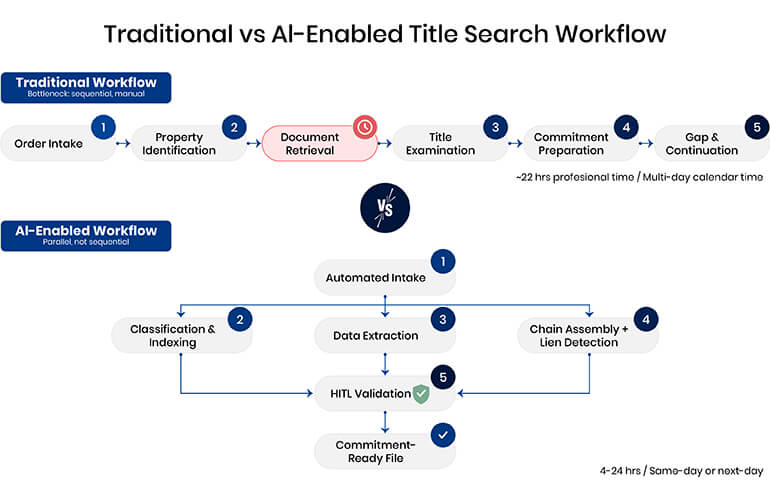
AI can compress the preparation stages, from document ingestion through lien search. The AI title search process also changes the order of work. Retrieval, judgment searches, and deed chain construction can run in parallel, where a manual pipeline runs them one after another.
The automated title search process begins with ingestion from county recorder systems, title plant feeds, and client documents, through direct integrations, APIs, or structured scraping. Inputs range from native digital files to scanned PDFs, TIFF images, typed instruments, and handwritten historical records.
Classification models trained on jurisdiction-specific patterns sort ingested documents by instrument type. They separate a warranty deed from a quitclaim deed, a mortgage from an assignment, and a mechanic’s lien from a judgment lien.
Because layouts differ by county, a new county’s documents typically need to be represented in training and validation data before the model handles them reliably.
Each document is typically tagged with its recording date, instrument number, grantor, grantee, legal description, and property identifier.
Title plant indexing with AI classification turns archives of scanned instruments into structured records that can be searched by property, party, or instrument.
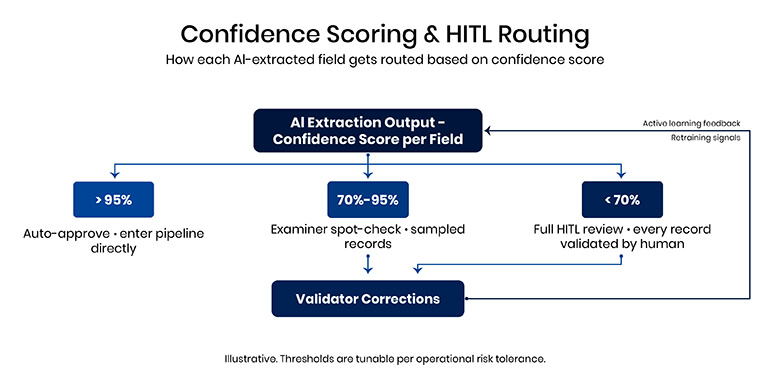
Field-level extraction assigns a confidence score to each extracted field, such as party names, recording dates, and legal descriptions, based on how reliably the system read the instrument.
Reading quality sets the ceiling for legal document processing OCR. Provider data drawn from more than 1,000 U.S. county formats puts field-level accuracy at 70 to 80% for OCR alone, 95%+ for purpose-built AI extraction, and 99%+ once human-in-the-loop validation is added. Field-level accuracy here means correct fields as a share of all fields checked in a validated sample.
In one provider-reported deployment for a U.S. real estate data aggregator, data accuracy rose from about 90% to validated accuracy above 99%, with low-confidence and critical fields sent to people for review.
Entity resolution models track grantor-to-grantee relationships across successive instruments. They can rank name variants such as “John A. Smith,” “John Allen Smith,” and “Smith, John A.” by cross-referencing recording dates, property identifiers, and instrument relationships. A change of capacity, such as an individual becoming a trustee, or any match without a supporting recital goes to an examiner instead of being merged automatically.
Gap detection flags missing transfers, grantor-grantee name mismatches, and dual conveyances of the same interest. Each conflict goes to a reviewer with the source documents attached.
For a full chain of title analysis covering decades of instruments, automation assembles the chain before the abstractor starts, and each link stays tied to its source document.
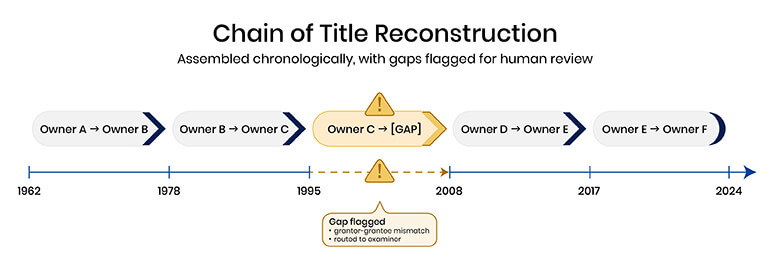
The lien and encumbrance search checks the chain for open mortgages without satisfactions, outstanding tax liens, judgment liens against chain parties, and mechanic’s liens within the statutory window. Each is ranked by recording date and the governing statute.
Some lien records sit outside the county recorder index, in court dockets, state tax offices or other state-designated filing offices, so a complete lien search covers more than one source.
Pattern detection can flag possible fraud, such as legal description mismatches, signature irregularities, or vesting changes without a recorded transfer. These go to an examiner for review.
An error in a commitment can mean a missed requirement or exception, and a missed lien or defect can become a claim. For that reason, every ambiguous extraction, exception, or low-confidence item goes to a human validator with links to the source.
Unreviewed automated data can carry the same risk into a commitment as a manual keying error. With review in place, the examiner receives a source-linked file with exceptions already flagged and can move straight to analysis.
Legal document processing OCR converts scanned instruments into machine-readable text. Inputs range from clean PDFs to handwritten 19th-century deeds, deteriorated paper, and typewritten carbon copies, which generic OCR tools often misread.
NLP for real estate legal documents reads meaning as well as text. It can interpret legal relationships and ownership structures written in jurisdiction-specific language.
To keep human review manageable at scale, the system passes high-confidence items through straight-through processing and routes low-confidence items to validators. Critical fields such as vesting, legal description and lien amounts still receive QC sampling whatever their score.
Lack of standardization is a basic barrier to title search across US counties, and no single configuration fits every county. The differences fall into four groups.
AI for title search automation handles this through cross-jurisdictional normalization. AI maps each county’s formats to a unified data schema, so the output follows one format from county to county. Each new county still needs its formats mapped once. After that, it can run on the same pipeline as the rest.
The figures below are provider-reported and vary with county mix, document quality and review rules.
Manual data entry at high volume can produce misspelled names, transposed dates, and missed instruments, which can become chain gaps or missed liens. Confidence scoring in title search can catch these at entry and send them for review. In a provider-reported engagement for one of the top four U.S. title insurance underwriters, automated extraction reached 85%+ accuracy, and human validation brought delivered output to the 100% accuracy target the client set.
Multimodal AI in title search is starting to read what text-only models miss, including plat maps, survey markings, and handwritten annotations, and examiners verify those readings. Data extracted from past files can also feed the risk models underwriters use for risk selection and claims analysis.
ALTA’s study with ndp|analytics found that title professionals spend about 22 hours on a standard transaction and 45 hours on a difficult one, across ten tasks from opening to final policy issuance, and that 36% of transactions in 2023 were difficult. Title production is one of those tasks, and it is the one preparation automation addresses. Title search support providers report a typical turnaround of 24 to 48 hours for a full search. In the underwriter engagement, 8-hour search orders were delivered in under 5 hours. Title search workflow automation makes lender deadlines easier to meet.
When AI prepares the file, examiners receive a pre-built chain and a flagged exception list, so more of their time goes to examination. Providers of AI-assisted preparation report a 2X increase in examiner productivity. The underwriter engagement recorded a 30% increase in analyst productivity. Abstractors gain too, because document review can start from flagged conflicts in a chain that is already classified and extracted.
Title examination automation can lower cost by reducing rework and manual keying. One AI-assisted data extraction provider reports a 60 to 70% reduction in data processing cost. The same teams can process more files, and lower error rates can improve unit economics as volume grows.
Scaling manual work usually means hiring in proportion to volume. AI title search solutions can separate throughput from headcount, so refinance surges need fewer new hires. For multi-state operations, adding a county or a state means mapping its formats into the existing schema. One pipeline can serve current owner, full, foreclosure, and lien searches by changing scope and depth.
Real estate title automation in 2026 centers largely on structured extraction and pattern matching. ALTA documents AI transforming title operations, describing it as already operating in real production environments. Qualia’s 2025 survey of more than 630 title and escrow professionals found nearly 9 in 10 use at least one AI tool, most often chatbots and predictive text, and nearly two-thirds report some concern about AI’s risks. Likely next developments include:
AI for title search automation targets the preparation work that comes before examination. By taking over the preparation steps from document intake to lien checks, AI delivers pre-built files to examiners and shifts their time from assembly to analysis.
Human examiners and underwriters remain the decision-makers, working within the same legal framework as before.
For title companies handling high volumes across many counties, AI title search solutions can let volume grow without a matching rise in staff, cut rework, and extend coverage to more jurisdictions, with accuracy and risk control leading the case.
Degraded and handwritten records are the ones most likely to fall below threshold and go to a reviewer.
State-level AI legislation is also moving, and NCSL’s analysis shows all 50 states introduced AI bills in 2025 and 40 enacted such measures. Later rules may add disclosure requirements for AI-assisted work.
A custom pipeline takes longer because it needs data infrastructure, jurisdiction-specific training, and ongoing maintenance. Either route can automate title search for title companies, and the choice usually turns on in-house engineering capacity and volume.
Whichever route you choose, ask four questions. How is accuracy measured, and on which fields. Where do human validators and QC sit in the process. How is nonpublic personal information stored, and is it used to train models. Can every extracted field be traced to its source instrument.
The job becomes confirming the chain, resolving the flags, and passing a verified file to the examiner. Throughput can rise without adding headcount.
What’s next? Message us a brief description of your project.
Our experts will review and get back to you within one business day with free consultation for successful implementation.

Disclaimer:
HitechDigital Solutions LLP and Hitech BPO will never ask for money or commission to offer jobs or projects. In the event you are contacted by any person with job offer in our companies, please reach out to us at info@hitechbpo.com