
What is Title Search: Process, Challenges, Automation and AI Best Practices
 Oct 5th, 2026
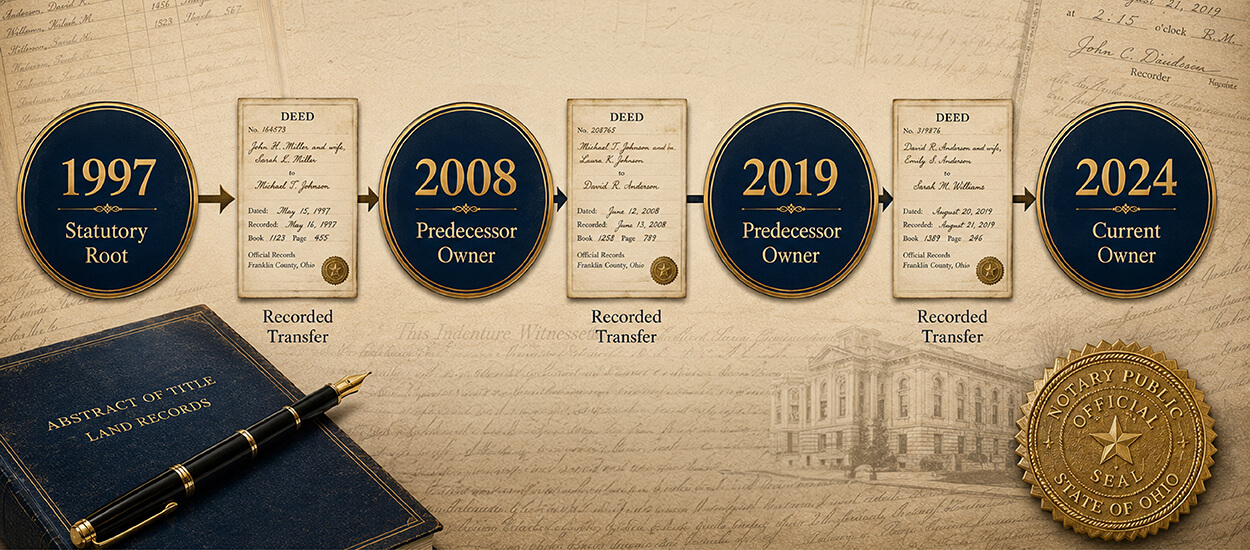
A chain of title is assembled from more than 3,000 US county recording offices, not pulled from a national registry. This guide covers how examiners trace ownership through grantor-grantee and tract indexes, the seven patterns that break a chain, the curative move for each, and where AI actually helps.
Table of Contents
The grantor-grantee index is the first place you look for a chain of title. It is also the first place it lies to you.
Wild deeds never appear, because the grantor is not in the prior chain. A paid-off senior mortgage can sit on the record for years with no release ever filed.
Mortgage assignments move through MERS and never return to the county. A deceased owner’s probate sits in a different county file entirely.
Tracing property ownership is reconstruction work, not lookup. That is what every examiner on our production floor does daily.
The US county records system spans more than 3,000 recording offices and three statute-type priority rules. No national authority ever centralized it.
This article covers the substrate, the mechanism, the judgment calls, and what AI does and does not solve. It draws on patterns we see weekly across 1,000+ US counties, 150+ document types, and 25+ years of chain work.
Three audiences carry distinct exposure to the same record.
Title companies run against turnaround clocks and claims ratios. Every delayed commitment is margin lost. Every claim-triggering policy drains premium revenue.
Real estate law firms build quiet title actions and curative filings on an examiner’s 30-year read. The filing is only as sound as the chain underneath it.
Underwriters set policy terms covering post-delivery risk. A missed lien becomes a claims exposure they either priced in or did not.
The numbers frame the stakes. The US title industry wrote $18.5 billion in premiums in 2025 and paid $667 million in claims, a raw loss ratio of 3.6%. That is low-probability, high-severity tail risk. Every missed recording is potential ammunition.
Property records sit with counties because every state modeled its recording acts on the Massachusetts Bay Colony’s 1640 ordinance. No national authority ever centralized the system.
A property records search in the USA rests on that federalism fact: 50 state statutes, thousands of recorder offices, and no unified index.
Recorders accept documents that meet form requirements and file them as submitted. Accuracy, legal effect, and chain construction rest entirely with the title searcher, because courts hold recorders are custodians, not adjudicators.
Errors stay on the record permanently. Correcting one requires recording a new instrument that references the error. Nothing gets deleted.
The custodial model produces roughly 3,600 separate recording jurisdictions: one per county, with one state-level statute shaping priority.
Deed records in real estate track transfers instrument by instrument. Each recorded item belongs to one of four functional classes, each with a distinct risk signal.
| Functional class | Examples | What they do | Risk signal |
|---|---|---|---|
| Financial instruments | Mortgages, deeds of trust | Attach liens against the property securing a loan | Lien stays attached until a release or reconveyance is recorded |
| Transfer instruments | Deeds (grant, warranty, quitclaim, special warranty, beneficiary, tax), mortgage assignments | Move ownership or security interest between parties | Warranty deed vs quitclaim deed decides whether the grantor warrants clear title or releases only what they hold |
| Involuntary liens | Tax, utility, lis pendens, HOA, mechanic’s, judgment, child support | Attach through non-voluntary action | Must be cleared before a clean conveyance; appear regardless of owner consent |
| Declarations | CC&Rs, easements, rights of way | Restrict use without transferring title | Do not break the chain, but restrict what the buyer can do |
| Court orders and judgments | Divorce decrees, bankruptcy rulings, quiet title orders, court-ordered sales | Move or restrict ownership through judicial action | Break the chain when an order never reached the recorder; cloud it when the order is contested or partly satisfied |
Court orders ride the same record stream as deeds with very different chain implications. We have seen divorce decrees splitting marital homes sit unrecorded for years, with the survivor’s later sale surfacing the gap.
A clean-reading deed chain can still carry attachments the buyer inherits. Read the substrate instrument by instrument.
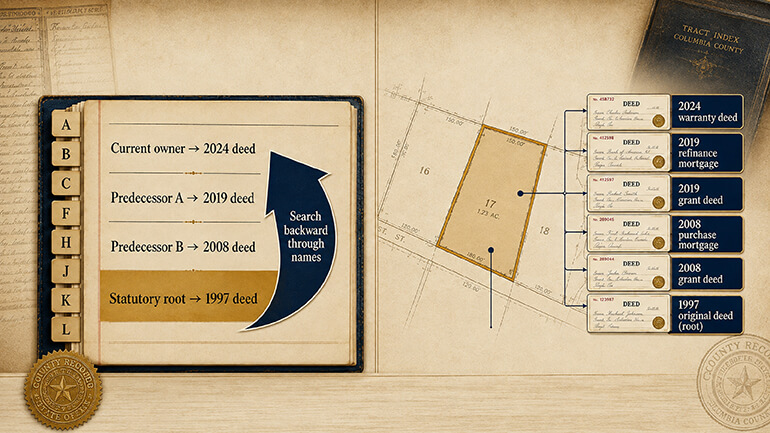
Grantor-grantee search is the majority path across US counties. You start with the current owner in the grantee index, find the predecessor, search that name, and work backward to the statutory root.
In the chains we work, a typical modern suburban parcel runs four or five links. A 2024 grantee traces to a 2019 predecessor, then 2008, then a 1997 root.
Older properties, multi-parcel splits, and probate-routed inheritances lengthen that chain fast. The mental model stays the same: backward-chaining by name.
Around ten of fifty states run tract indexing instead. Every instrument files under the parcel’s legal description rather than a party’s name.
Tract indexing pulls every document for a parcel at once and resolves the “John Smith” ambiguity outright. In a race-notice jurisdiction, a missed recording costs the buyer priority, so index design is not cosmetic.
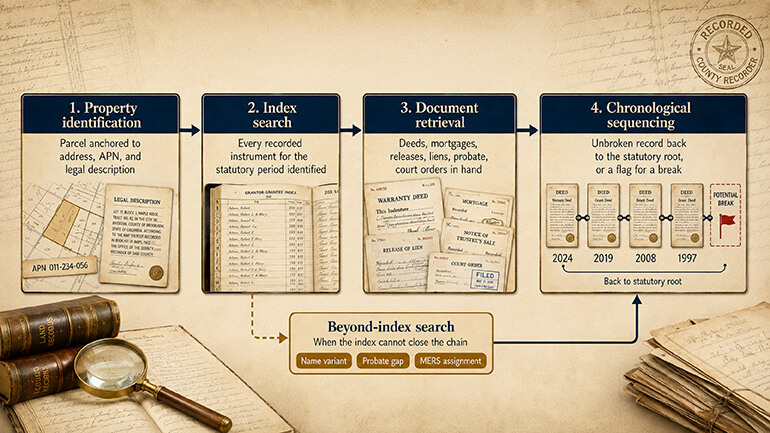
1. Property identification. Validate address, APN, legal description, and search type against county records. Confirm the parcel has no assembly or split issues hiding.
Search scope varies. A standard title search runs 30 to 40 years against Marketable Title Act scope. A full title search traces to the original land grant, and Texas examples go back to sovereignty.
Current-owner, two-owner, three-owner, refinance, and update scopes narrow further. Pick the scope before you start, not halfway through.
2. Index search. Work backward by grantee name in a grantor-grantee county, or by parcel in a tract county. Identify every instrument recorded against the parcel across the statutory period.
3. Document retrieval. Pull deeds, mortgages, releases, lien filings, judgments, tax records, probate documents, and court orders. Every identified instrument must end up in hand as a readable record.
4. Chronological sequencing. Build the ownership sequence link by link. Verify each grantor held title at the time of conveyance and that the parcel description stayed consistent.
The output is either an unbroken record back to the statutory root, or a flagged break at a specific transaction. Skip a stage, and the defect surfaces later in underwriting instead.
The real estate title search process is disciplined at every step. Skip one, and the defects show up later in underwriting.
Every transaction validates against five fields at once: grantor, grantee, legal description, APN, and date range. All five must align with the next transaction’s counterparts.
Each key fails differently, which is why you check all five rather than trusting one.
Any mismatch on any one key is your signal to search beyond the index. Five-field validation per link is what separates a senior examiner from a junior one.
One practical warning: miscited book/page cross-references and mistyped APNs turn a routine file into a multi-hour reconciliation. Validate metadata against the underlying instrument before trusting the index entry.
State and county recording systems operate across three statute types and four digitization tiers.
Jerry Lewallen, president of the Property Records Industry Association, put it plainly in a ProPlogix interview; “What happens in one recording office may differ from what happens in the recorder office of another state.”
That variance is the operational environment every multi-state examiner navigates daily.
| Statute | Priority rule | What the examiner must check | Example jurisdictions |
|---|---|---|---|
| Race | First to record wins, regardless of notice | Absolute earliest recorded deed in the chain | North Carolina, Louisiana (limited) |
| Notice | Subsequent bona fide purchaser wins if no notice of prior unrecorded transfer | Constructive notice sweep | Florida, Mississippi, others |
| Race-notice (majority rule) | Subsequent purchaser must have no notice AND record first | Both priority order and notice verification | New York, California, most common-law states |
Florida shows what race-notice demands operationally. Combined with a 40-year Marketable Title Act (F.S. § 712), it raises the stakes on every recording inside that 40-year window.
| Tier | Access Method | Typical Turnaround | Where Used |
|---|---|---|---|
| Digital title plant | Tract-indexed, Big 4 underwriter plants | Same day | Most major metropolitan counties |
| Online public index + scanned images | County recorder website, search by name or tract | Hours | Most mid-to-large counties nationwide |
| Scan-only, no online search | Email or in-person pickup | 2-3 days | Smaller counties, older record sets |
| Paper or microfilm only | In-person visit required | Week+ | Rural counties, pre-digitization archives |
Availability differs sharply by tier, and that difference sets your realistic turnaround before you write a single line of the abstract.
Multi-county work also crosses security-instrument conventions. Trust deeds rather than mortgages dominate in fourteen states: AK, AZ, CA, CO, ID, IL, MS, MO, MT, NM, NC, TX, VA, WV.
Concentration matters too. Four national underwriter families hold approximately 85% of US policies and maintain private title plants layered on county records.
Texas statutorily requires title companies to own or lease a plant, so plant access there is cost of entry rather than an optional layer.
Chain of title issues split into two failure modes.
A break in the chain is a missing link: a grantor-to-grantee leap the index cannot bridge. A cloud on title is a defect on an otherwise complete chain, such as an unresolved claim, unreleased lien, contested boundary, or encroachment.
Both demand curative work, but the path differs. The seven break patterns below recur often enough that you pattern-match them on sight.
| Break pattern | What it looks like | Curative move |
|---|---|---|
| Wild deed | A recorded conveyance whose grantor does not appear in the prior chain – title passes nothing | Trace the grantor’s actual acquisition; affidavit of title or quiet title action |
| Missing release on paid-off senior mortgage | Clean-reading chain with a senior lien still attached; payoff happened, but no release reached the recorder | Contact lender or servicer for payoff evidence, record the release retroactively, cross-check the title plant |
| MERS assignment gap | Servicing-rights transfer moved through MERS but never reached the county – note-holder cannot enforce | Verify current servicer via MERS lookup; require a recorded assignment before the chain can close |
| Probate interruption | Owner died intestate or with a will never properly probated – grantor-to-heir link invisible in index | Pull probate records from probate county (frequently not property county); locate and record the decree |
| Corrective deed chain | Later corrective deed indexed under correcting party rather than original grantor | Pull both original and corrective; confirm book/page citation; ensure corrective is indexed to original grantor |
| Name variants | Spouse-added titling, corporate-successor transfers, trust vesting, Jr/Sr/III mis-indexing | Alternate-spelling searches, corporate name histories, trust instruments, affidavit of identity |
| Tax deed interruption | Chain breaks at delinquency; new owner’s chain origin is the tax sale | Confirm statutory notice procedures; verify redemption period cleared; obtain tax-sale documentation |
Dozens of break patterns exist beyond these seven, but these cover most of what our production examination sees in a normal week.
Unreleased liens are the expensive ones. The chain reads clean right up until underwriting catches the missing filing.
Clouds surface differently. The chain reads unbroken, but something on an existing link creates uncertainty: outstanding judgments against a prior owner, boundary disputes, a garage encroaching across a setback line, or an unrecorded easement claimed through long use.
The remedy there is not tracing a missing link. It is negotiating or litigating the disputed interest until the commitment can issue.
Resolution is craft, not lookup. Three routine moves close most breaks before escalation.
Cross-reference a title plant. Plants frequently carry records that never reached county filing, so a missing release often appears in a plant’s update log. This saves hours.
Validate the legal description against the original deed. This resolves most corrective-deed chain breaks without escalating anywhere.
Review multiple county sources. Probate files from one county resolve gaps in another. Tax assessor maps cross-referenced with deed descriptions close multi-county cases that single-county search leaves open.
Name-variation breaks get a specific instrument. An affidavit of identity filed into the record confirms that two spellings refer to the same person.
That covers Lily Smith and Lilly Smith, or a grantor shown as “John Smith Jr” in one deed and “John P. Smith III” in the next.
Metes-and-bounds or grantor-name errors in prior deeds call for a correction deed: a new recording that references and fixes the original.
Neither instrument requires court involvement. Both close breaks in days rather than weeks.
When none of these moves works, a quiet title action through the courts is the last resort.
ALTA’s minimum standards require examination back to a “good root of title”, which is at least 40 years in many states under Marketable Title Acts.
Title examiners, called abstractors in much of the industry, are the judgment layer sitting above the index.
Across 25+ years supporting US title companies in 1,000+ counties, the cleanest commitment files we see are the ones where the examiner knew when to stop trusting the index.
Each retrieved instrument gets reviewed against five-field validation. The emerging break pattern gets recognized. The curative path gets escalated to whoever is best placed to close it.
The deliverable is the title abstract: a chronological summary of every recorded instrument affecting the property, with every link verified and every issue flagged.
The commitment draws from the abstract. The examiner’s judgment decides what enters it and what stays in the escalation queue.
The index surfaces what was recorded. The examiner surfaces what was missed.
Historical records are where commodity automation defeats itself without telling you.
Pre-1980 handwritten deeds, cursive signatures, abbreviated metes-and-bounds from early-1900s ledgers, damaged scans, and non-standardized county forms all produce extraction errors that standard OCR cannot flag reliably.
A Colorado chain we worked ran into 1800s documents. A Georgia county we handle still runs scan-only archives. Both demand human reading.
We have scaled this historical-tail work before on city-directory archives where the records predate every standard OCR assumption.
Digitization has closed much of the modern-format gap. The historical tail has not moved.
In our production, three business days to pull a probate file is normal. A week to reconstruct an archaic legal description with a stamped survey is not unusual either.
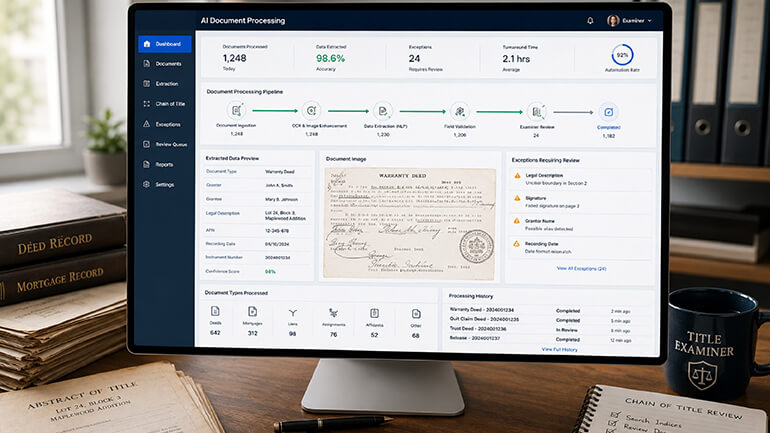
Intelligent document processing has a precedent in the title plant itself. Title insurers began computerizing private deed banks in the 1960s, and public recorders followed in the 1970s.
What has changed is the extraction layer. OCR reads typed and printed deeds. NLP pulls grantor, grantee, legal description, APN, recording date, and instrument number. Computer vision handles scanned images, stamps, and signatures.
Across the 150+ document types our abstraction teams process daily, the system flags ambiguous fields for examiner review rather than guessing at them.
Automated property data extraction earns the turnaround compression without replacing the examiner. We run it daily.
Automation fails quietly on pre-1980 handwritten and non-standardized legacy formats. That is exactly why the production model runs human-in-the-loop: the machine extracts and flags ambiguity, and a person validates and decides.
AI-powered title search preparation works because production runs through validated judgment, not around it.
Property data normalization is what unlocks multi-county scale.
Every county writes its records in its own dialect: different instrument-type naming, different field ordering, different abbreviation conventions.
Normalization maps those dialects into a unified schema with confidence scoring on every extracted field.
That lets a commitment-ready file build the same way whether the data came from a digital title plant in Texas or a scan-only recorder’s office in rural Pennsylvania.
We have handled 200-parcel portfolios across eight states that settle into one structured dataset instead of eight incompatible ones. We have also scaled this from two counties to 345 for a large US property-records operation.
Structured versus unstructured property data is the real scale problem. OCR accuracy on modern records is not.
Accurate chain of title delivery compounds three business outcomes.
Commitment timelines compress. Manual multi-county chains run 5 to 7 days. Hybrid production with AI extraction plus examiner validation runs 4 to 24 hours on standard orders.
Underwriting follow-up drops. Clean commitment files with verified linkages cut the back-and-forth that eats examiner capacity.
Claims exposure falls. A missed lien or unrecorded probate becomes the underwriter’s exposure. The industry paid $667 million in claims in 2025, and fraud and forgery remain the largest loss categories.
In our work with a top-four US title insurance underwriter, 4-hour orders delivered in 2.5 hours and 8-hour orders in under 5 hours after adopting structured extraction plus human-in-the-loop validation.
That produced a 30% productivity gain and 85%+ automated accuracy, with human review at 100%.
eRecording adoption keeps extending toward all 50 states. A PRIA study found more than half of documents eRecorded across 622 jurisdictions, up from 38% in 2014.
API-based county access is becoming standard in digitized jurisdictions. Ownership-graph modeling supports portfolio-scale work where entity-ownership patterns matter more than single-parcel construction.
Blockchain experiments point toward property-owner-controlled title data, but none has implemented a truly decentralized system at scale. None replaces the examiner either.
The county records substrate does not change. Technology compresses the work. Judgment still closes it.
The chain is a construction, not a retrieval.
It assembles out of county records that were never designed as a single system, indexed by conventions that vary across thousands of local dialects.
Breaks and clouds live exactly where the index stops speaking.
AI and intelligent document processing compress the search work. Examiner judgment closes the chain. The production model that scales does both together.
What’s next? Message us a brief description of your project.
Our experts will review and get back to you within one business day with free consultation for successful implementation.

Disclaimer:
HitechDigital Solutions LLP and Hitech BPO will never ask for money or commission to offer jobs or projects. In the event you are contacted by any person with job offer in our companies, please reach out to us at info@hitechbpo.com