
How AI Automates Chain of Title Verification
 Nov 10th, 2026

AI can classify recorded instruments and extract the fields used to verify conveyances and reconcile liens. Configured matching and validation rules use those fields to check each link, flag unresolved findings and prepare draft commitment schedules with source references.
Table of Contents
A chain of title is the recorded sequence of conveyances that connects the current owner to a legally sufficient starting point, known as the root of title. Chain of title verification confirms that every link in that sequence is valid, that each grantor held what was conveyed, and that every lien against each owner was released, subordinated or carried into the commitment. In a long chain, that work repeats for every link and every owner in the file.
AI takes on the repeatable evidence work in that process, and every unresolved check goes to an examiner with its reason and source records.
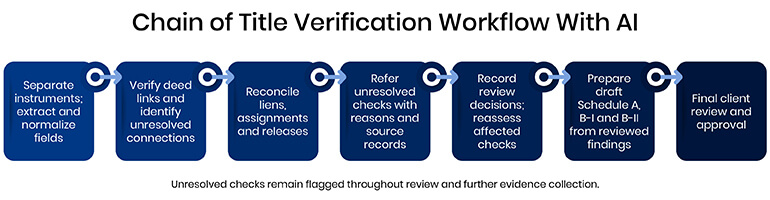
Bulk records from county land portals often combine several transactions in one multi-page PDF or TIFF, so verification begins by separating the file into individual instruments. Each instrument’s pages stay together, so extraction does not attach one deed’s parties or legal description to another. Ground searchers obtain records unavailable online.
Scans are deskewed and contrast corrected, then read by optical character recognition for typed text and handwriting recognition for handwritten calls and marginal notations. Older microfilm and cursive instruments produce lower-confidence text, and that confidence carries into review routing. Layout segmentation then detects instrument boundaries from recording stamps, signature blocks and notarial acknowledgments.
Each instrument is then classified as a fee conveyance, security instrument, assignment or modification, lien satisfaction, involuntary lien, authority instrument (powers of attorney, trust certifications, affidavits of heirship) or land restriction (easements, CC&Rs, plats, mineral reservations).
The class decides the route. A deed enters the ownership chain as a candidate conveyance, a Certificate of Satisfaction goes to lien reconciliation, authority instruments are linked to the conveyance or release they support, and land restrictions feed Schedule B, Part II.
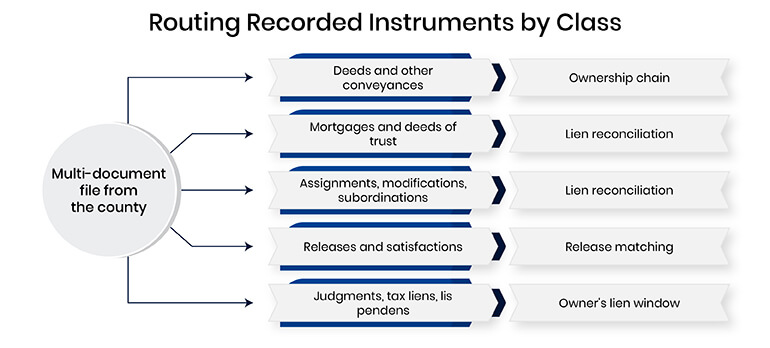
After classification, extraction captures party names and roles, tax parcel identifiers, legal description calls, recording data and recitals that cite earlier instruments, and normalization puts them into consistent fields so successive instruments can be compared.
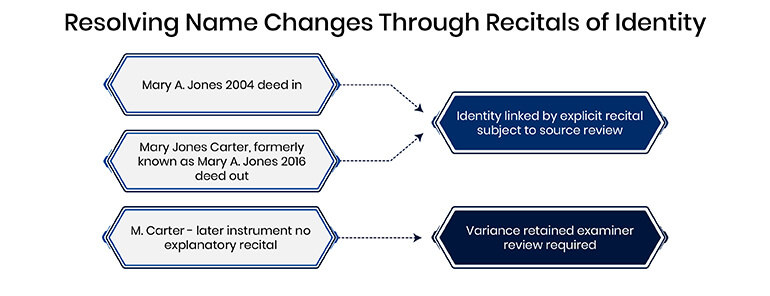
Exact name matching can reject a valid link. An owner who bought in 1998 as Katherine M. Howard and sold in 2018 as Katherine Howard-Miller would look like two parties unless the variation is resolved.
The workflow ranks candidate matches using name parsing, similarity scoring and nickname matching, but a score alone never creates a link. It reads each conveyance for identity recitals such as formerly known as (FKA), now known as (NKA), successor by merger to, or trustee of a named trust. The Texas Title Examination Standards let an examiner accept such a recital unless there is reason to question it (Standard 3.40). With no recital, the names stay unlinked and the deed goes to an examiner with the disparity highlighted.
Verification starts with the current deed and works backward, checking how each grantor acquired title. Where a supporting deed is missing, the grantee index guides follow-up retrieval.
Ownership is not always a single line, because co-owners, life estates and partial conveyances branch the chain. Each link carries the type and share of the interest conveyed, and every branch is traced to the root of title. Before a link is accepted, the deed passes an execution screen for signature, acknowledgment, required witnesses and recording stamp, plus spousal joinder and homestead requirements where state law applies.
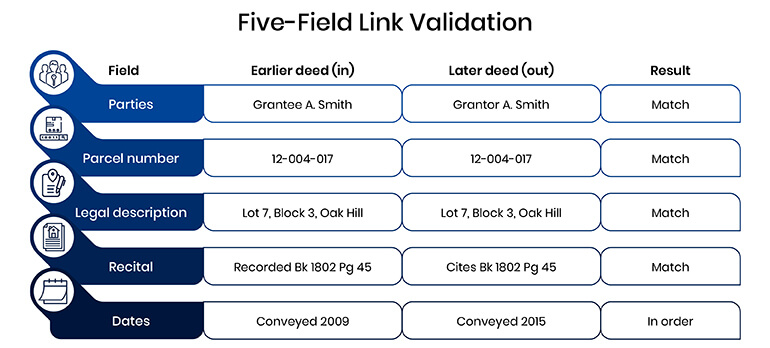
Each candidate link is tested against five sets of evidence, assessed together.
A check that cannot be completed because evidence is missing, a field is unreadable or processing fails never counts as a pass. The link goes to an examiner with the reason recorded.
The example below shows agreement across all five comparisons.
The backward search continues until it reaches the root of title under the state’s marketable title act. In Ohio, marketable record title rests on an unbroken chain of 40 years or more, as the Supreme Court of Ohio summarized in Erickson v. Morrison (2021).
Florida’s Marketable Record Titles to Real Property Act uses 30 years, with exceptions in section 712.03. Interests created before the root survive only where the chain refers to them specifically, as with the mineral reservation repeated in each deed in Erickson. The examiner decides whether each reference is specific enough.
When link checks cannot connect an instrument to the recorded ownership sequence, the workflow flags it for review and never supplies an unrecorded conveyance.
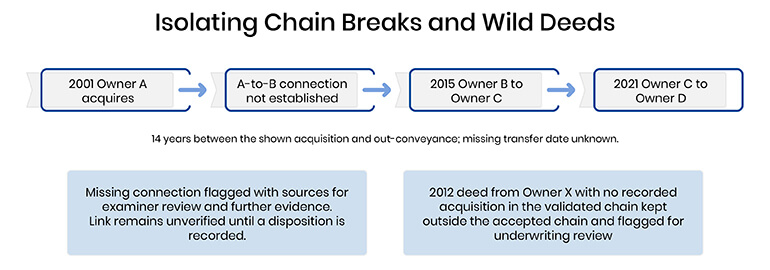
A wild deed is a recorded deed whose grantor has no recorded title in the chain. The workflow builds the ownership sequence from instruments retrieved by parcel, legal description and owner name, because judgments and many older deeds cite no parcel number.
A deed whose grantor never appears as a prior grantee, or acquired title only after the deed was recorded, stays out of the chain and goes to underwriting review as a wild conveyance.
A chain break occurs when a link in ownership is missing from the record. If Owner A acquires title in 2001 and the next recorded deed is executed in 2015 by Owner B, the chain is broken between A and B.
When the backward search finds no deed from A to B, the workflow
Where title passed by inheritance, Texas Standard 11.70 allows reliance on an affidavit of heirship to establish who the heirs are, absent information to the contrary.
Verification also requires confirming that every monetary lien against every owner in the chain was released, subordinated or carried into the commitment as a requirement or exception. The search for each owner runs from acquisition to the filing of the out-conveyance, the per-grantor window in the Texas standards, and covers contractual and statutory liens, including federal tax liens, mechanic’s liens, judgments and lis pendens (Standards 15.10, 15.20, 15.60 and 15.110).
Each mortgage is grouped with its assignments, modifications, subordinations and releases. A subordination changes priority and does not close the lien (Standard 15.90). The workflow also records each lien’s filing date, renewal status and the state’s expiration rule, so expired liens are not carried forward.
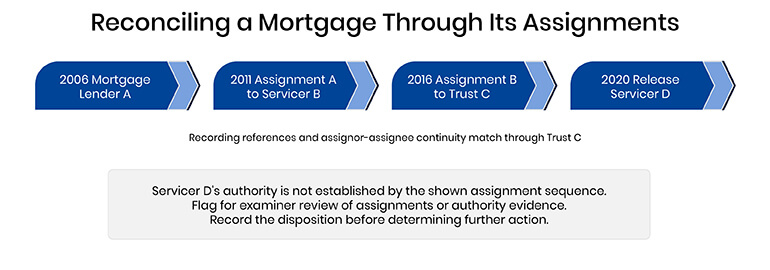
Assignments are checked for a recorded link to the master mortgage, an unbroken run of assignors and assignees, and record authority for the party that signed the release. If a mortgage assigned to Servicer B and then Trust C is released by Servicer D, the examiner checks for a recorded power of attorney or servicing authority first. MERS assignments get the same check against the nominee language in the security instrument.
Every unresolved name match, missing assignment or uncertain legal call reaches an examiner with the check result, the reason for referral and the source references, and the record separates conflicting evidence from missing evidence and processing failures.
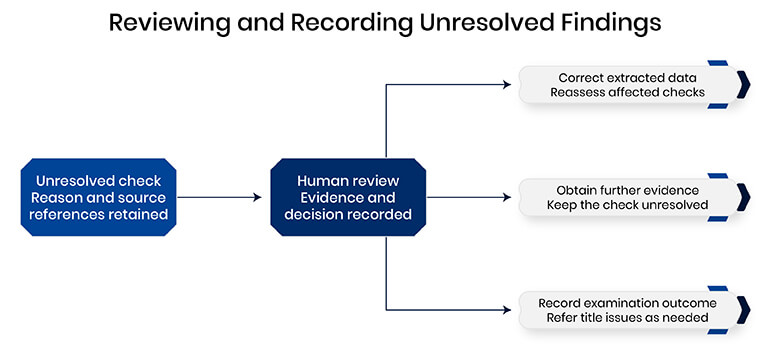
Source validation in intelligent document processing keeps each extracted field linked to its source record, with validation status, field confidence and an audit trail. Where the interface supports it, selecting a field highlights the source text. Reviewers correct errors, request more instruments, rerun affected checks and record their disposition.
Confidence scores route the work. Clear platted chains with fully matched satisfactions can pass straight through to draft commitments, while degraded microfilm, handwritten legal calls, name variances without recitals and open senior mortgages go to experienced examiners. Independent QC follows, and final approval stays with the client’s licensed title agent, attorney or underwriter.
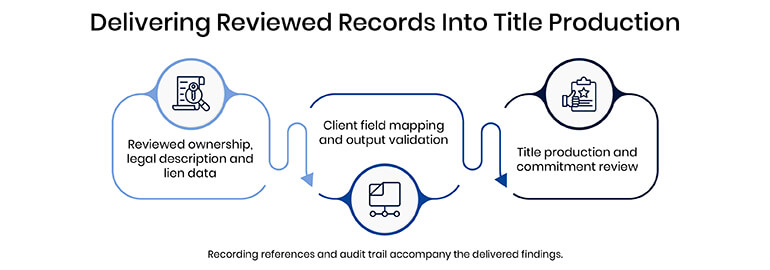
The reviewed findings feed the draft ALTA Commitment for Title Insurance for examiner approval.
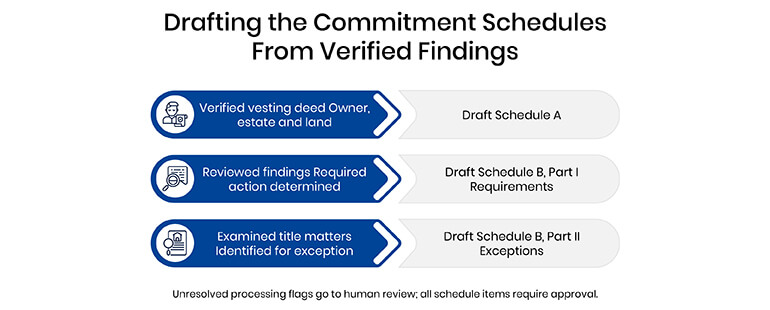
Title search support outputs include a search report and structured ownership, legal description and lien data delivered through APIs, SFTP or flat files, including SoftPro and ResWare, in the client’s field mappings. Fields can follow PRIA and MISMO standards, and recording references and the audit trail travel with each finding. Requirements and exceptions still need examiner approval.
The matrix compares manual chain of title verification, OCR alone and a configured AI-assisted workflow at each stage.
Comparing Chain of Title Verification Approaches
| Verification Work | Searcher or Examiner | OCR Alone | Configured AI-Assisted Workflow |
|---|---|---|---|
| Instrument preparation | Separates and classifies records | Recognizes text | Detects boundaries and classifies instruments |
| Party and property matching | Compares names, recitals and descriptions | Provides text only, no valid-link test | Extracts and normalizes fields, flags unresolved matches |
| Chain and lien checks | Traces conveyances, matches assignments and releases | No relational checks | Tests configured relationships, flags missing links |
| Commitment preparation | Enters or imports schedule data | Provides text only | Maps findings to draft Schedule A, B-I and B-II |
| Evidence and review | Checks findings against source records | Positional data depends on the tool | Carries source references and review decisions |
Before adopting an AI-assisted workflow, or a provider that runs one, agree on these controls.
AI handles the repeatable evidence work behind chain of title verification, and accountability stays with people. Unresolved checks stay flagged with their sources until an examiner decides the next step, and the client’s licensed professional approves the commitment.

What’s next? Message us a brief description of your project.
Our experts will review and get back to you within one business day with free consultation for successful implementation.

Disclaimer:
HitechDigital Solutions LLP and Hitech BPO will never ask for money or commission to offer jobs or projects. In the event you are contacted by any person with job offer in our companies, please reach out to us at info@hitechbpo.com