
What is Title Search: Process, Challenges, Automation and AI Best Practices
 Oct 5th, 2026
Invoice Processing Services manage invoices from receipt of vendor invoices to the payment of the invoice. Doing it inhouse increases costs and slows the process cycle. Outsourced invoice processing services increase operational efficiency and reduce the cost of processing invoices.
Table of Contents
Did you know that the gap between processing invoices manually and through automation is as high as 80%? Companies doing it manually spend between $12.00 and over $16.00 for single invoice processing. The cost includes labour, errors and long cycles. On the other hand, automation reduces this to as low as $3.00 per invoice.
If you process around 2000 invoices per month, the manual charges will range between $288,000 and $384,000 annually, while automation reduces this to around $72,000. Imagine the savings and freedom from hassle of errors and reworks.
It is all about financial calculation, and your finance team has been dealing with this cost for years without realizing it can be solved. This blog will take you through the benefits of outsourcing invoice processing. Outsourcing data processing not only shifts your workload, but it also gives you access to expertise and automation. Apart from cost saving it also saves you from operational bottlenecks.
Still relying on manual invoice processing?
Invoice processing outsourcing, also known as accounts payable outsourcing, is when businesses outsource invoice processing to a managed service provider.
The service provider manages the complete task right from data capture to validation, approvals and payments. The service provider combines technology with skilled teams to deliver outcomes. Even with your own automation system the workflow needs monitoring.
Invoice processing services ensure accuracy, scalability, and compliance by taking full ownership of your AP function.
The Institute of Finance and Management (IOFM) benchmarks and industry analyses indicate that the average manual processing costs $12.90 average per invoice while the median is $7.90. The average cost of processing a non-PO-based invoice is between $18 and $25 per invoice.
Businesses claim that invoices without PO orders cost almost 3 times more than invoices with PO. Non-PO invoices are unstructured and require manual processes such as pre-approvals, validation and coding. Automation can replace these manual processes where AI-driven data capture and rule-based processing reduce cost and cycle time.
Apart from this, many factors increase the manual invoice processing costs. As per research by APQC, labour costs consume 62% of total AP costs. Manual intervention is needed because of errors in purchase orders, shipping documents and other such tasks that requires human to step in.
Industry data suggests that manual AP errors can be up to 5% invoice which can compound across invoices. Each error leads to a whole long process where you need to contact the vendor, detect the issue, reprocess an update the GL. This can be both time-consuming, expensive and accuracy cannot be guaranteed.
Automation pares down invoice errors by up to 80%. Most of the outsourcing service providers are well equipped with AI-assisted techniques like IDP that supports quick and accurate invoice processing. Once the invoice error improves through automation it reduces the overall department cost, penalty repayments and eventually overall improves efficiency.
The Cash Flow Dimension
Days Sales Outstanding (DSO) measures how long it takes a company to collect cash after making a sale on credit. Now any company would aim for lower DSO as it would mean faster cash collection while a higher DSO would imply that the cash is stuck with customers.
To understand in terms of hard cash; if your business works on $2 million in monthly receivables then a 1-day DSO carries roughly $933,000 in outstanding receivables at any time. But if you can manage to reduce that DSO to 5 days it can bring the figure down to $333,000, freeing $600,000.
If you remain stuck with manual processing your DSO will always remain high, as the entire manual process goes slow. Right from invoice creation to errors, recycling, approvals, all get delayed, pushing payment further down.
Also, with payment delays, suppliers often make up by increasing pricing or reducing early payment incentives. Often there is a discount for early payment which gets missed due to delayed invoice processing and then delayed payment. Your business may also miss early payment discounts such as 2/10 net 30.
Outsourcing to experts can address many invoice processing challenges.
The decision to keep invoice processing in-house may look good initially as it gives more control and flexibility. But it can lead to operational bottlenecks and become a source of hidden costs. Here are 5 consequences businesses may face from keeping invoice processing in house.
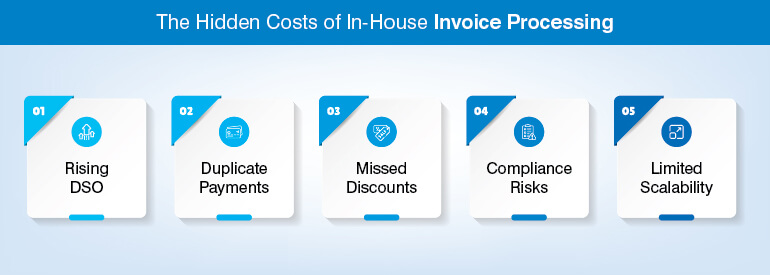
Manual processing timelines are much higher compared to automated outsourced invoice processing. While with manual processing, the approval cycle averages 14 days, with automated outsourced invoice processing it averages 3-5 days. The gap of around 9 days directly impacts working capital as it increases DSO. Businesses also miss out on any discounts that is offered for early payments.
On average, 0.8% to 2% of companies’ annual disbursements are duplicate or erroneous, as per data from the American Productivity & Quality Center. A study by SAP Concur reported that 1.29% of the invoices businesses process are duplicates. Avoiding duplicate payments is important as it leads to major financial loss. Automating invoice data extraction and approval routing is a good idea to avoid erroneous or duplicate payments.
Manual invoice processing is time taking and error prone rarely meeting the 10-day deadline. In the process, the standard 2/10 net 30 discount often gets missed. 2% for payment within 10 days is worth 36% on an annualized basis. This is one of the highest risk-free returns available in the financial sector. Automation speeds up the workflow, accelerating approvals and enabling scheduled payments.
3-way match failures often lead to compliance failures. This core control ensures PO, receipts, and invoices align properly before payment. And this is possible only through automation. Manual handling creates inconsistencies that leads to overpayments, duplicate payments or inaccurate accruals. This also leads to weak audit trails that increases risks and gets difficult to justify transactions. Business leaders now have to certify financial accuracy as per SOX Section 302, and manual gaps can weaken this assurance.
Invoice volumes spike unpredictably, especially during month-end and seasonal peaks. Doing invoice processing inhouse fails to scale without hiring and training new staff. And putting undue pressure on the team multiplies errors and reworks. And backlogs build up, delaying invoice processing, and thus delaying payments. Outsourcing helps absorb such volume fluctuations as service providers can easily scale up or down.
These inefficiencies compound quickly across invoice volumes.
The benefits of outsourcing invoice processing are not only theoretical. There are measurable benefits in how automation and expert handling can drive gains. Here are a few important ones.
The gains are measurable across cost, speed, and accuracy.
| Factor | Manual In-House | Outsourced + Automated |
|---|---|---|
| Cost per invoice | $8–$14 (labour, overhead, error rework) | $1–$4 (per-invoice or retainer pricing) |
| Approval cycle | 14 days average | 3–5 days with automated routing |
| Error rate | ~5% (data entry errors, PO mismatches) | <1% (OCR capture + validation rules) |
| Scalability | Requires additional headcount to absorb volume spikes | Volume bands handled within existing SLA |
| ERP integration | Manual GL posting | Direct API push to QuickBooks, NetSuite, SAP |
| Audit trail | Paper-based or inconsistent | Full digital log per invoice, every step |
| Fraud detection | Manual review only | Rule-based flags and anomaly detection |
| Compliance coverage | Dependent on individual staff knowledge | Built-in checks: SOX, GAAP, GST/VAT |
Outsourcing is definitely a good solution and provides measurable benefits, but it may not be a good solution in all situations. Consider factors such as volume, complexity and scale before you take a decision. Here are 3 factors that must be considered.
These tools, however, may have certain limitations like the need for human review, and for that you can always take support from experts.
The transition to the outsourcing process must be structured and aligned to avoid any unnecessary delays. Here are 4 structured handover phases.
| Phase | Name | Weeks | What Happens |
|---|---|---|---|
| 1 | Discovery & Setup | 1–2 |
|
| 2 | Pilot Processing | 2–4 |
|
| 3 | Parallel Run | 4–6 |
|
| 4 | Full Handover | 6–8 |
|
Pricing depends on multiple factors like whether you are looking for monthly plan or per invoice plan. Also, the volume and complexity of the project will add to the cost. But here is the basic structure.
| Pricing Model | Typical Range | Best Suited For | Key Consideration |
|---|---|---|---|
| Per-invoice | $0.50–$2.50 per invoice | Mid-size businesses: 500–5,000 invoices/month | Confirm whether exception handling is included or billed separately |
| Monthly retainer | $1,500–$8,000/month | Businesses with stable, predictable monthly volume | Fixed cost simplifies budgeting; verify SLA penalties for missed targets |
| Volume tiers | Declining rate per unit | Enterprises processing 5,000+ invoices/month | Unit economics improve at scale; negotiate tier thresholds at contract signing |
Setup fees that mostly covers ERP integration, workflow setup and pilot batch generally range $500-$3,000. But with high volumes, there could be a slight fee waiver. Always check for exception handling terms, charges for failed invoices and confirm inclusion before pricing.
Understanding cost is the first step to making the right decision.
Outsourcing invoice processing is no longer only about the cost; it is more about the technology that improves accuracy and speed.
This improves accuracy and speeds up invoice processing cycles. Modern IDP platforms including ABBYY FlexiCapture and Google Document AI works as additional support with machine learning on top of OCR to handle non-standard invoice formats.
This is a huge support for invoice processing providers as it reduces manual intervention and increase processing speed. On the practical side, it automatically reduces cost per invoice with lower error rates and improved scalability.
It tracks the full invoice lifecycle, which reduces fraud risk, leading to strong compliance and greater transparency. This keeps the system always audit ready, and that matters most for SOX-compliant organizations.
Invoice processing is a complex process that is time bound and requires high accuracy. Doing it inhouse adds to hidden costs that compound over time. Manual processing slows down the process, is error prone and businesses even miss out on early payment discounts. Outsourcing and automation improves cost, speed, accuracy and compliance.
When you plan for outsourcing invoice processing, the goal is to build a scalable and well-structured system and lighten internal processes. Take your call based on regulatory needs, volume and process maturity.
With growing complexity in invoice processing, technology and automation continue to reshape and rebuild the approach towards invoice processing.
It is the practice of delegating the entire invoice processing task to a service provider. The provider takes charge of the complete process right from invoice capture, 3-way PO matching, validation, approval, payment schedule and GL posting.
Outsourcing offers multiple benefits as you get access to AI enabled automation, faster processing cycles and high accuracy. The service providers use high end automated systems like OCR, IDP and automated validation rules. To ensure accuracy and exception handling, the service providers also employ human reviewer.
There is a huge cost gap between invoice processing inhouse and invoice processing outsourced. Service providers can do it at a very low cost as they use automation for the complete workflow. If we calculate it, inhouse invoice processing costs $10 per invoice, while when you outsource it the cost per invoice reduces to $2 per invoice.
You also save on setup costs, internal team and training costs. Early payment discount capture and avoidance of late penalties also add to your savings.
Yes, outsourced invoice processing is 100% secure.
But you need to do your due diligence before partnering with a service provider. You need to check their security certifications like ISO 27001 or equivalent. And the service provider must show that they encrypt all invoice data during transfer and storage. For healthcare clients, you need to confirm HIPAA Business Associate Agreement (BAA) coverage.
Transition is a very structured process which takes around 4-8 weeks. If we break it down, it roughly takes 2 weeks for pilot processing, 2 for parallel runs, and finally the complete handover is done by the sixth to eighth week.
This is a general guideline for the transition, but in case of high exception rates and custom approval hierarchies, the timeline may extend a bit. Don’t opt for a 2-week complete handover even if the provider insists. Because without a parallel run there could be chances of error post transition.
Outsourcing service providers integrate with many ERP systems, but just don’t go by the platform name. It is a good idea to do test posting before the parallel run begins. Also, many service providers may do additional integration in case of custom ERP environments.
Most of them integrate with QuickBooks Online, NetSuite, SAP (ECC and S/4HANA), Oracle Fusion, Microsoft Dynamics 365, and Xero.
What’s next? Message us a brief description of your project.
Our experts will review and get back to you within one business day with free consultation for successful implementation.

Disclaimer:
HitechDigital Solutions LLP and Hitech BPO will never ask for money or commission to offer jobs or projects. In the event you are contacted by any person with job offer in our companies, please reach out to us at info@hitechbpo.com