
How Chain of Title Works – Tracing Property Ownership Through County Records
 Aug 24th, 2026
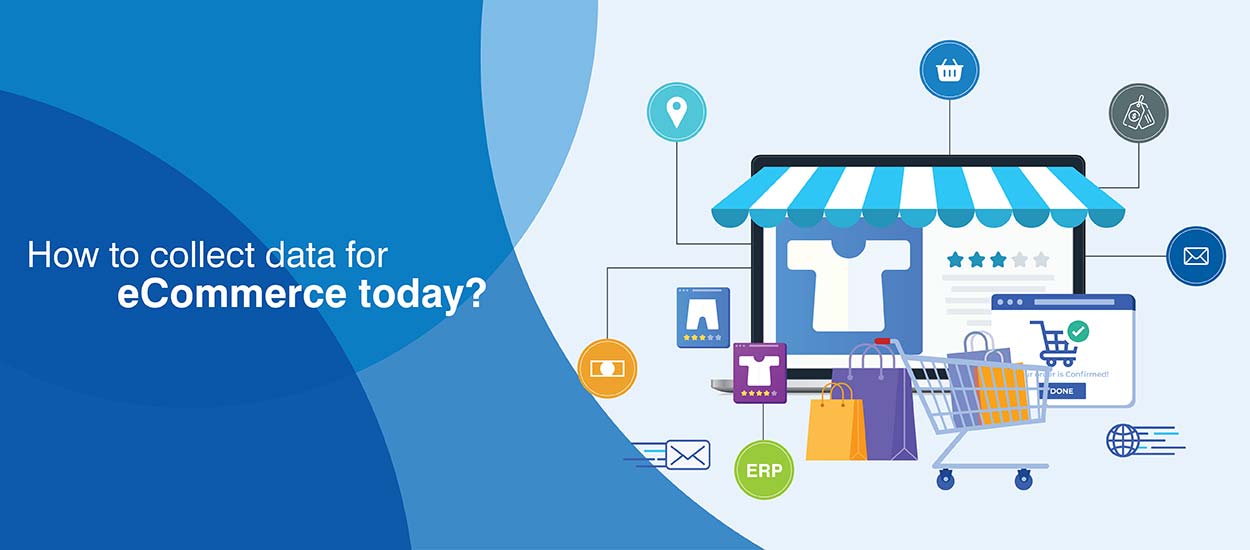
Ecommerce companies depend heavily on accurate and near real time product data for steering pricing, assortment and customer strategy. Data requirements of social media signals and demographics have not only increased the demand for processed high quality eCommerce datasets but also expert ecommerce data collection partners.
Table of Contents
Accurate, complete and relevant data is the fuel for this modern ecommerce industry. Structured and near real-time data collection helps online retailers, marketplaces and ecommerce data aggregators to make informed strategic decisions about pricing, assortment and customer engagement. In absence of precise data collection, analytic pipelines get paralyzed, product feeds become inconsistent and pricing models lose that silver lining.
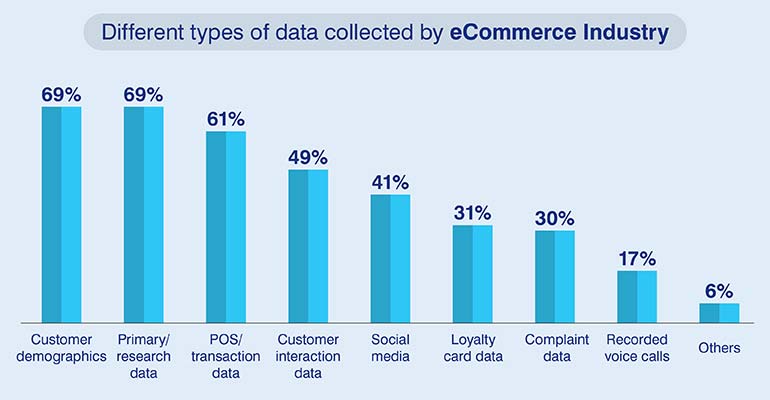
Here let’s have a quick look at various structured and unstructured data types that many organizations collect. But times are changing very fast and so are the data needs of eCommerce players. They now are required to augment existing data about their customers with hundreds of consumer and business specific variables including household income, presence of children in the home, and/or number of employees at a particular office and much more.
It’s not surprising that traditional data sources still dominate, but we’re seeing a steep surge specifically in the area of social media. Ecommerce players have started considering that a post or comment by a well-respected or widely followed customer has the potential to influence millions to buy, or in some cases not to buy, and can have a big impact on your revenue.
In this article we talk about top 10 eCommerce data collection strategies with relevant examples for each of them. It’s a fine combination of automated data collection and intelligent analytics that empowers eCommerce platforms to cope up with concurrent market dynamics.
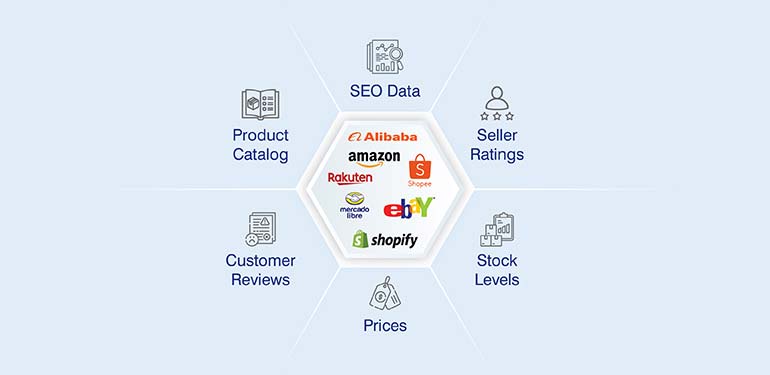
eCommerce players have not understood that titles, specifications, SKUs, images and product attributes hold a lot of important information to build a really strong foundation of completeness and pricing comparison for their product catalogs. Manually scrapping product data at scale from multiple platforms like Amazon, Walmart or eBay is time-consuming, error prone and proves costly.
But leveraging structured HTML parsers and dynamic XPath selectors fast-tracks clean extraction of attribute level product data ready to be integrated and mapped to internal systems.
Having to adapt to frequent DOM changes and antibot mechanisms adds to the challenge. With so many challenges, outsourcing eCommerce data collection to experts often proves to be a smart move. Specialized data collection firms use adaptive scrapers, rotating proxies and structure tracking algorithms to make sure continuity even when page templates keep changing.
Example: An online retailer of home appliances partnered with a data collection service provider to successfully extract product attributes from across 3 diverse marketplaces. The data collection company not only assisted them to unify the taxonomy but also helped them to map the scraped fields into its product information management – PIM system. This improved the catalog discoverability by 30%.
Optimize Your eCommerce Data Pipeline.

Robust and agile extraction of product price and product rating data plays an important role in ensuring continuous monitoring of market prices, discounts and review sentiment. This price transparency helps online retailers to stay competitive. The process of scraping price and rating data is all about scheduling the tasks and API integrations to gather or collect data about base prices, discounts, average ratings and review counts at regular intervals. This gathered data is then parsed and appended to the ERP or pricing engines using structured feeds.
We deploy automated pipelines to take care of scheduling, proxy rotation and trigger based updates to maintain live datasets of our clients without overloading the sites we are scraping the pricing and rating data from.
Example: Hitech BPO assisted a leading electronics retailer in the USA to integrate real-time pricing feeds in their internal pricing engine. It empowered the retailer to automate repricing across 50,000 plus SKUs, improving price competitiveness and margin accuracy from 8% to 12%.
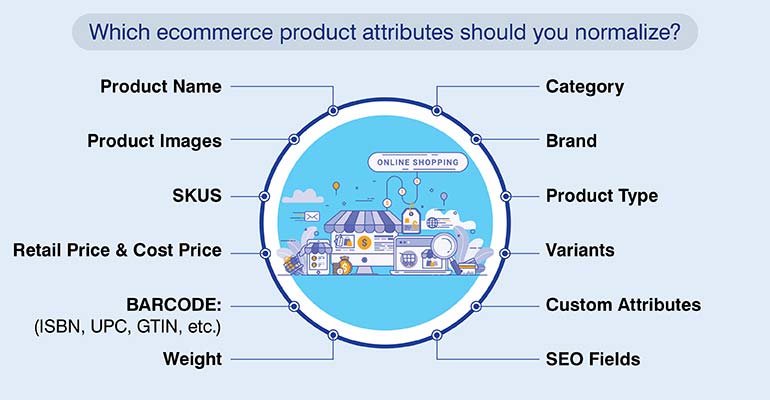
Information collected from diverse sources don’t have a predefined data model or is not organized in a predefined manner. Chances that a product is listed under different names, attribute orders or units are very high. Attribute level product normalization aligns product attributes like brand, model, size and color to make sure consistency of product information across datasets.
HitechBPO leverages robust machine learning models to recognize attribute equivalence even if the field names are different across sources. It reduces manual curation efforts saving a lot of time and cost. The normalization workflow includes:
We collected and normalized 2 million-plus SKUs collected from across 7 vendor sources for a fashion data aggregator. It reduced their duplicate records by up to 40% and improved the feed quality for downstream analytics.
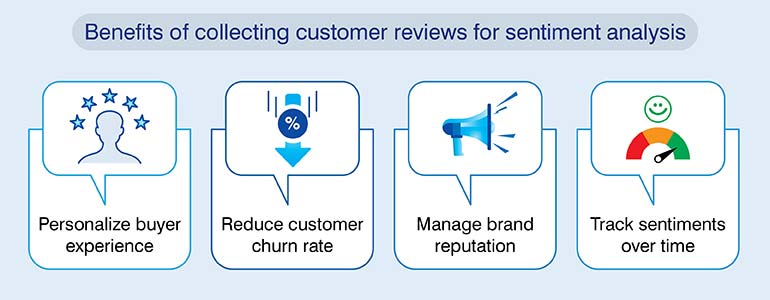
User generated content like customer reviews holds really valuable insight into product quality, product pricing and customer satisfaction. Collecting such reviews from across marketplaces, forums and brand pages to analyze customer sentiments empowers brands to detect issues early on and adapt faster. But unstructured textual form of data, multilingual comments and processing emoticons to assess the precise intent of customer comments pose a challenge for ecommerce players.
We deploy an automated workflow with minimal human intervention that scraps textual reviews, does language preprocessing and runs sentiment classification models to assess emotion intensity and polarity. Furthermore, we put at work natural language processing – NLP to convert raw review text into structured sentiment scores to help our clients to quantify customer perception.
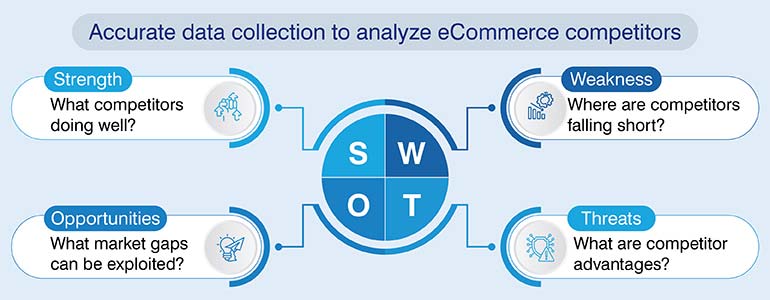
Staying ahead of competitors is no longer an added advantage. It’s now become a complete necessity for ecommerce companies. 9 out of 10 shoppers compare prices before making a buying decision online. This makes it essential for brands and retailers to monitor competitor prices and optimize product prices accordingly.
With ever evolving consumer expectations, gradually expanding markets and digital technologies reshaping how brands engage with their customers competitor intelligence has emerged as a strategic solution for online retailers to flourish, adapt and lead. To gain competitive intelligence, ecommerce players depend on structured product data collection solely focused on competitor product assortments, stock status, promotions and new launches.
We use automated crawlers to scan competitor storefronts, detect new SKUs and track historical changes in price, stock and discount levels. There are times when we deploy headless browsers to render JavaScript heavy pages for complete visibility. In the end, we combine data from multiple marketplaces and present the data in form of competitive intelligence dashboards to help our clients get a unified view of how competitors evolve.
Streamline Product, Price, and Market Intelligence.
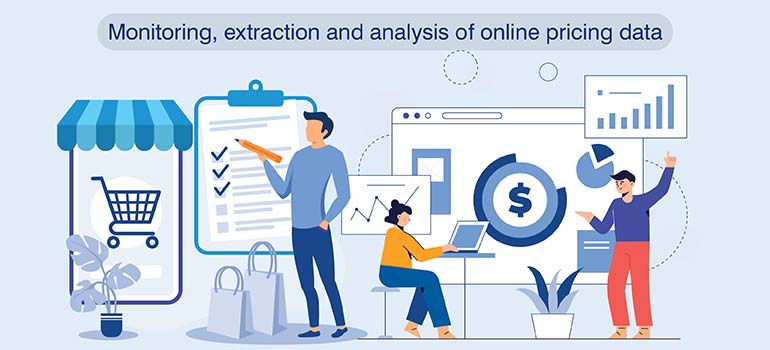
Smart pricing is not optional for ecommerce companies. It affects the visibility, conversions and long term profitability in volatile ecommerce markets. And all this is due to shifting demands, emerging competitors and dynamic pricing strategies.
Data collection for ecommerce price intelligence is the automated process of monitoring, extraction and analysis of online pricing data gathered from competitors, marketplaces and consumer behavior. Pricing intelligence empowers online retailers to remain competitive, maximize profits and adapt quickly to real-time shifts isn consumer demand and market pricing trends.
Our robust workflows are designed to connect automated scraping with price optimization systems for continuous market alignment. As part of our price intelligence solutions, we deliver structured price feeds directly into client’s analytics environment. It reduces efforts, cost and time consumed in manual data aggregation. Daily price feeds are normalized and merged with internal product datasets. Then rule based pricing logic is used to determine optimal pricing decisions.
Cut Operational Costs with Automated Data Collection.
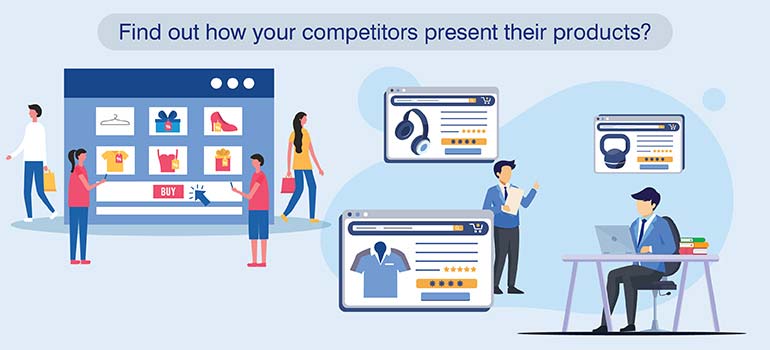
360 degree product images, product photos, product videos, etc., are capable of influencing the conversion rates. But missing out or inconsistent product photos across listings dents buyer trust. Scraping product images regularly makes sure that all media assets including product images, videos and metadata are captured and standardized. The process includes activities like automated extraction of image URLs, bulk download and hashing to detect duplicates. And not only this, metadata like resolution, color format and file size is extracted for keep a tab on quality.
We integrate scheduled image scraping routines with our client’s Digital Asset Management – DAM systems, to make sure centralized media governance.
eCommerce companies scrape product images from marketplaces to find out how their competitors have presented their product offerings. Everything right from packaging, angles, background choices and quality. Data collected from these scraped images is further used to train visual recognition engines or recommendation systems to suggest similar looking products.
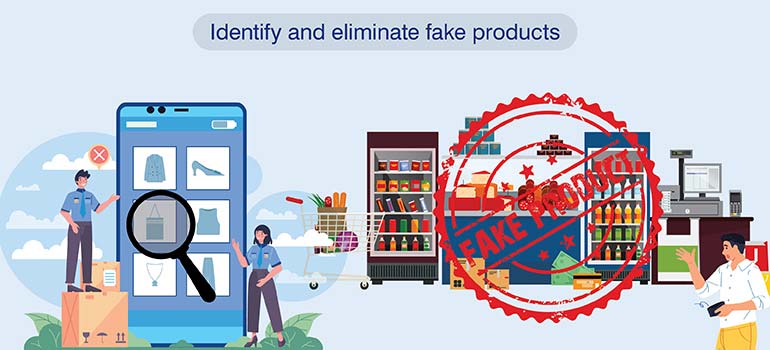
In 2021, counterfeit goods were estimated to account for USD 467 billion, or 2.3% of global imports. It’s equivalent to the GDP of some of the OECD economies. This underpins the scale and persistence of the threat for ecommerce companies.
Counterfeit product listings erode brand trust and hence revenue. For ecommerce companies to detect such fake listings, require automated scraping of product identifiers like SKUs, titles, seller IDs and images from marketplaces. Pattern matching systems are then used to match the data against verified brand databases. Image hashing and textual similarity algorithms effectively flag suspicious listings. All this helps in identifying unauthorized products and sellers.
Doing an anticounterfeiting scrape is a cumbersome process. With nearly 7.9 million online retailers across the globe, searching them all manually or by using a bot is a tedious, almost impossible process. We’re experienced at designing and deploying anti-counterfeit monitoring systems, which is a combination of image recognition, metadata comparison and automated alerts for suspect listings.
Upgrade Your eCommerce Insights with Clean, Structured Data.
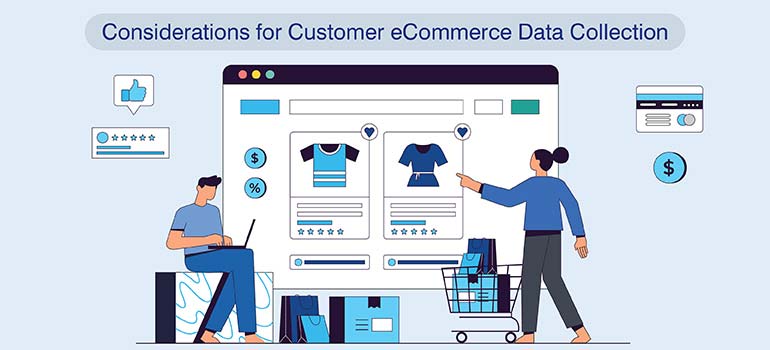
One size fits all belief fails here as well. Generic scrapers or scraping tools readily available in the market fail when data sources differ significantly in structure or logic. But custom made data scraping frameworks are equipped to handle multidomain, multiformat data collection requirements from across diverse data sources. These frameworks combine API extraction with HTML crawling, manage distributed workloads via message queues (Celery, Kafka) and rotate proxies for assured reliability.
We’ve successfully designed, deployed and maintained custom scraping architectures for our ecommerce clients, where taxonomy complexity is high. Our AI Web Scraping APIs help you extract product details, reviews, competitor info and pricing from any site. Once extracted, our clients can export clean, structured data in CSV, JSON or XML ready for analysis.
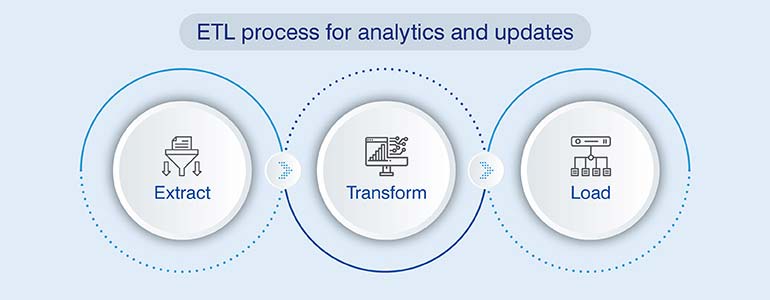
Raw data collected from diverse data sources is more than often unstructured and needs to be processed to make it usable. ETL – Extract Transform Load process is used to convert collected ecommerce data into structured and ready to use clean feeds for analysis, reporting, automated platform updates and several other activities.
The ETL process is a fine combination of various data processing activities including parsing raw data, removing duplicates, validating schemas and transforming outputs in JSON, XML or CSV. The output data is ready to be integrated with business intelligence tools or marketplace APIs for instant updates.
Our ecommerce data collection teams leverage scalable frameworks like Python, Node.js and SQL based ETL systems to build robust and agile data pipelines. It makes sure accurate, near real time and automated data update.
Scalable and compliant data collection requires governance, security and automation. Putting these practices in place makes sure sustainability and accuracy:
| Best Practice | Best Practice | Summary |
|---|---|---|
| Governance & Compliance | Ethical and legal data collection | Respect robots.txt, site terms and comply with GDPR, CCPA and relevant data privacy regulations. |
| Scalability | High volume, cloud-based scraping | Use cloud native architectures such as AWS Lambda or GCP Functions for parallel, scalable data collection. |
| Data Validation | Data quality and integrity | Apply checksum comparisons and schema validation before ingestion to maintain accuracy and consistency. |
| Security | Protection of collected datasets | Encrypt data at rest and in transit and enforce strict access control policies. |
| Monitoring | System reliability | Put logging, retries and anomaly detection alerts in place to catch scraper failures or changes in site structure. |
As one of the best ecommerce data collection company we manage ecommerce data scraping environments using these standards for all our clients. Our data collection processes are designed and deployed in a manner to make sure that all our clients receive reliable, validated and compliant ecommerce datasets that can scale as their business grow.
So, as we observed, ecommerce data collection has grown from meager data gathering activity into a process of engineering structured, high-performing datasets to fuel business intelligence. Every strategy mentioned in the article, right from marketplace scraping to anti counterfeit monitoring, describes how to collect ecommerce data, structure it and deploy it to reap maximum benefits. Hiring expert and experienced data collection company will enable ecommerce platforms, online retailers and aggregators to put these strategies in place in an efficient and cost-effective manner.
What’s next? Message us a brief description of your project.
Our experts will review and get back to you within one business day with free consultation for successful implementation.

Disclaimer:
HitechDigital Solutions LLP and Hitech BPO will never ask for money or commission to offer jobs or projects. In the event you are contacted by any person with job offer in our companies, please reach out to us at info@hitechbpo.com