
How Chain of Title Works – Tracing Property Ownership Through County Records
 Aug 24th, 2026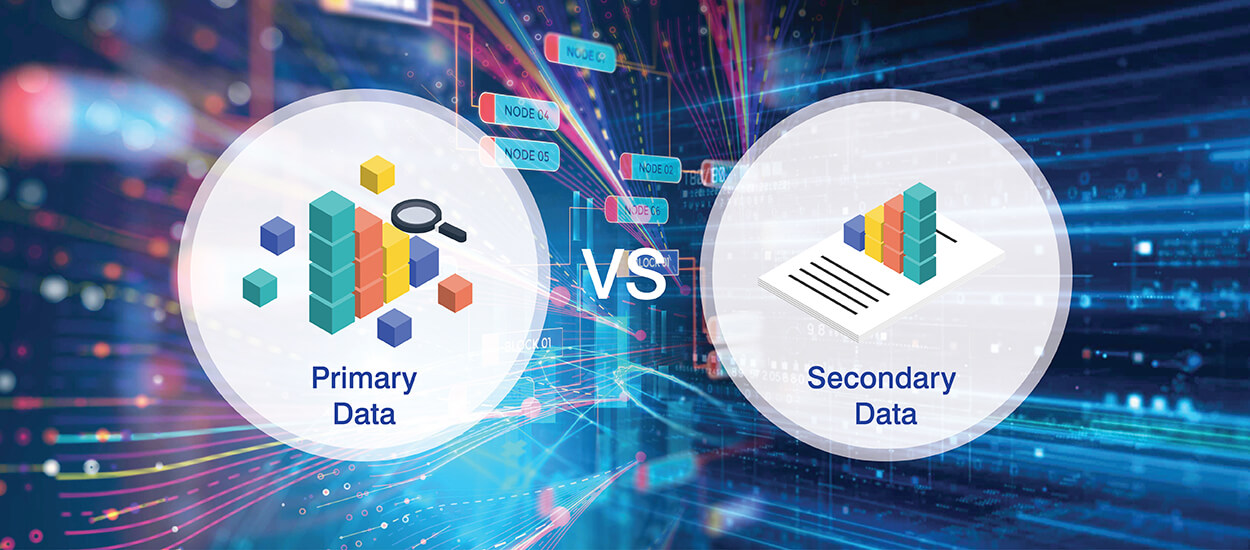
With the correct primary and secondary data at your disposal, you can make data-driven decisions to chart the course of your business functions. While primary data shows you what is relevant and where to focus, secondary data offers context and the path to scale.
Table of Contents
Businesses are being challenged by the fact that their data volume is growing at a greater rate than the time it takes to make the data available for decisions. Businesses have vast amounts of data and very few are able to use the actual data insights they need when making decisions.
Around 82% of marketing research firms use secondary data for business and competitive intelligence, while secondary analysis can save nearly 40–60 % of the time compared to primary data collection processes.
In order for an organization to develop a strategic application of primary vs secondary data – not as an academic research discipline, but as a decision-making discipline; this will be critical to its success.
Primary Data (immediacy & specificity) and Secondary Data (scale & context) have both strengths and weaknesses on their own, but when used together, provide clear judgments, less risk, and allow for faster alignment of decision-making among various groups within the organization.
This article will describe five different primary vs secondary data examples that will show how businesses can apply the concept to ultimately produce better, more confident outcomes.
What is primary data?
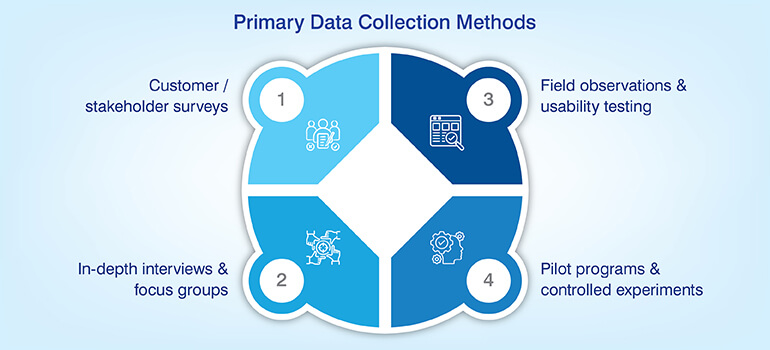
Primary data is data collected by a business from the source itself in order to answer a particular question about a business-related objective, either immediately, or shortly thereafter. As such, primary data is typically built around a purpose; the data is collected for a reason that is determined by the questions that business leaders want to have answers to.
Strategically speaking, primary data can be distinguished from other forms of data in three ways:
What is secondary data?
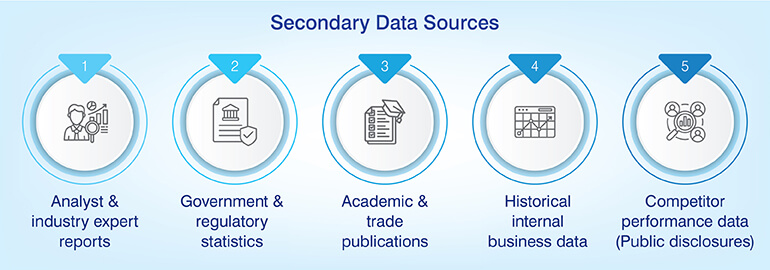
Secondary data is existing information (previously collected) that was not specifically for your use but can be used to inform you. It’s usually created from outside of your organization to support an analysis related to a larger market picture.
Some examples of typical secondary data sources for business are:
The benefit of using secondary data is its speed and ability to provide a big-picture view of the overall environment.
Using secondary data can help you to identify:
In terms of when to use which (primary or secondary data in business) there are several factors to consider based on leadership views. But none of those say you should choose either over the other. What you are looking at is how best to sequence your use of each type of data and what you intend to accomplish.
Using a combination of both secondary and primary research to develop the most sustainable business data collection strategies and methods will help you create a better overall understanding of your company’s position as well as support the development of the most accurate business decisions.
Secondary research helps frame your environment and identify the right hypothesis to test through primary research; primary research then validates your hypothesis and provides real-time feedback. Here is a quick primary vs secondary data comparison.
| Factor | Primary Data | Secondary Data |
|---|---|---|
|
Purpose-fit
|
Highly specific |
Broad context |
|
Cost & time
|
Higher |
Lower |
|
Control
|
Full |
Limited |
When combined, this approach transforms your data from an input to an output, providing you with the ability to make informed decisions that can be grounded in the context of your company and supported by valid data as well as provide you with the opportunity to achieve measurable results. This balance allows a cost comparison of data collection methods without sacrificing quality.
Turn data into confident, actionable business insights
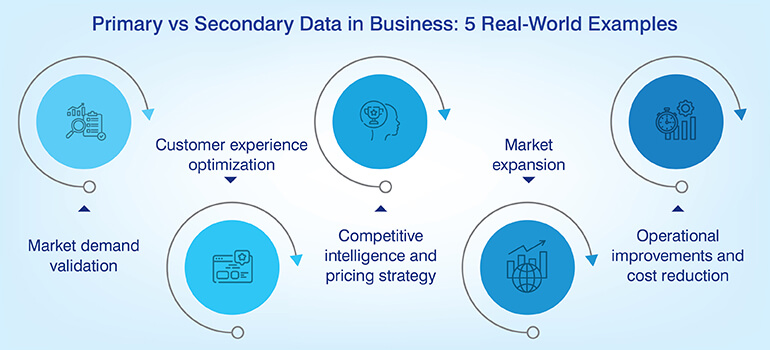
When launching a new product, it is inherently uncertain as to whether that product will be in demand, especially when there are weak or fractured signals of demand. As a result, companies need to transition away from simply relying on their intuition and toward using a very deliberate primary vs. secondary data methodology to validate an opportunity prior to investing company resources.
Primary data is a key tool when there is no existing data set that captures the actual demand for a product that does not exist yet. Companies primarily utilize direct customer research to test assumptions regarding value, price and differentiation.
Some of the key use cases for primary data include:
All of these primary data collection techniques provide highly detailed information as to whether the conceptualization of the product resonates with its target audience.
However, primary research is most productive when supported by a solid understanding of the context. It is here that secondary data for business adds significant strategic value.
Secondary data is often utilized for the following purposes:
Therefore, this is not a decision to make between primary and secondary data; rather, it is a methodical combination of both. The secondary data provides guidance for what should be tested, while the primary data provides insight into what is important.
Ultimately, the result is a much more balanced business data collection methodology that reduces risk while increasing confidence in product/market fit.
Customer experience can be improved in ways beyond simply reviewing previous performance metrics. Organizations tend to allow their reliance on historical data to continue to create service gap issue.
This is due in part to an organization’s lack of validation of current customer experiences with each service interaction point. Thus, using both primary and secondary data will provide organizations the needed balance.
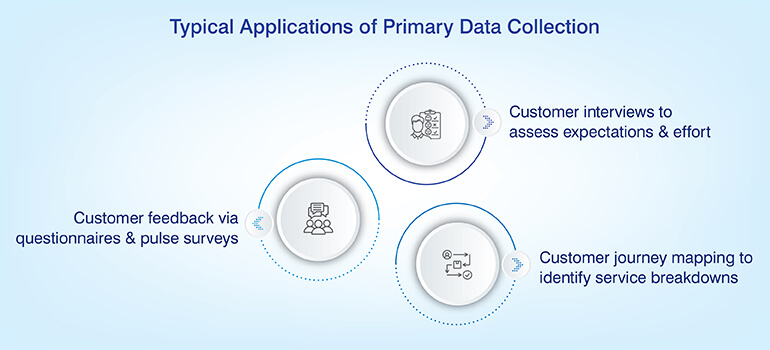
Primary data use case
The collection of primary data allows organizations to identify the real time perception of customers and the emotional drivers of those perceptions that are unaccounted for in transaction-based systems.
Primary data provides value in identifying the “friction” experienced by customers at service interaction points.
Typical applications for collecting primary data include:
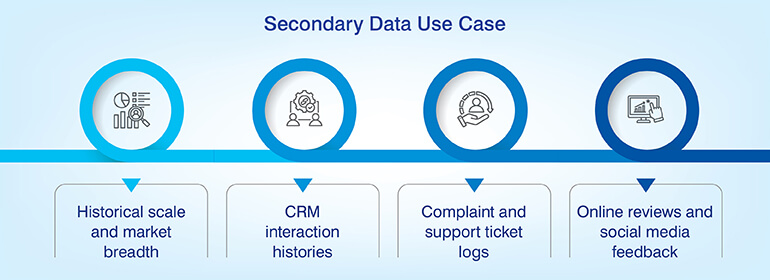
Secondary data use case
Secondary data adds historical scale and breadth by examining existing information including:
Outcome
By layering new primary insights over legacy secondary data, organizations can prioritize CX improvements more accurately and help reduce customer churn while also enhancing long term service consistency and customer trust.
Transform secondary data into actionable business intelligence.
Pricing and positioning decisions require more than surface-level competitor tracking. Businesses must understand not only what competitors charge, but how customers respond to those price and feature signals, making the primary vs secondary data distinction especially relevant.
Primary data use case
Primary data helps capture real customer reactions through:
These methods reveal how customers interpret competitor offerings in real buying contexts.
Secondary data use case
Secondary data enables rapid market visibility by analyzing:
Outcome
Combining real customer perception with large-scale competitive data allows businesses to price more precisely and adjust positioning with confidence.
The main challenge of making a “market expansion” decision is that you are supposed to make decisions based on “high-level indicators”. In that case, it’s crucial to know how to use primary vs secondary data when you are going into new geographic or demographically targeted markets.
Use case for primary data
Primary data will give you localized and “ground level” information from field surveys regarding local consumers’ preferences and purchasing habits as well as from focus groups in order to identify the needs that have not been met and the obstacles to adopting products.
Primary data also includes direct responses from stakeholders to regulatory or compliance issues.
Use case for secondary data
Secondary data can provide a broader view of the market in terms of macro trends as seen by government statistics and censuses as well as published market research data types and demographic studies. Additionally, secondary data can include regional infrastructure and economic trend reports.
Outcome
By combining primary data to understand your target market with secondary data to establish macro trends in the market, you can reduce your exposure to risk associated with an expansion strategy and develop more targeted strategies to enter into the marketplace.
The use of both primary and secondary data can provide an organization with sufficient insight into identifying improvements in process efficiency that will deliver real Return On Investment (ROI).
Primary data use case
Primary data informs how work really works by:
Secondary data use case
Secondary data provides an external perspective via:
Outcome
Decision makers are able to determine which operational improvement projects have the greatest potential to achieve cost savings and improved efficiency by comparing firsthand operational knowledge with comparative benchmark information.
As businesses scale their use of data for decision-making, the most common challenges aren’t accessing data, it’s ensuring the quality of data, its consistency and timeliness.
That’s when working with a provider who specializes in data workflows becomes a strategic advantage.
By outsourcing data workflow to a provider such as Hitech BPO, organizations can operationalize a primary vs secondary data strategy that is more efficient, without adding to the complexity of managing that strategy internally.
Hitech BPO supports primary data workflows in several ways, such as:
Hitech BPO also supports secondary data workflows by delivering scale and speed through:
Hitech BPO transforms dispersed third-party information into reliable business intelligence data sources.
What makes this a key differentiator is how the data is processed. Automated tools enable data to be collected and extracted at a much higher rate than manual processes, but human oversight is provided to ensure that the data being used is contextual as well as to maintain data accuracy and reliability.
The effectiveness of an organization’s decision-making processes is dependent upon how well they utilize primary data (for the most current information) and secondary data (historical and/or published for general knowledge) in different departments within its company.
With increasing data complexity, it is also increasingly important to have experienced assistance with applying primary and secondary data in an effective manner. HiTech BPO assists organizations to be able to leverage this strategic opportunity to convert raw data into actionable insights that will help them execute more efficiently and grow over time.

What’s next? Message us a brief description of your project.
Our experts will review and get back to you within one business day with free consultation for successful implementation.

Disclaimer:
HitechDigital Solutions LLP and Hitech BPO will never ask for money or commission to offer jobs or projects. In the event you are contacted by any person with job offer in our companies, please reach out to us at info@hitechbpo.com